




Classification Board and Review Board Annual Report 2023–2024
October 2024
Annual report
© Commonwealth of Australia 2024
ISSN: 1327–6182 (Print)
ISSN: 2981–8869 (Online)
This Annual Report 2023–24 is protected by copyright.
With the exception of third-party material, the Commonwealth Coat of Arms, and any material contained within which is protected by trademark, all material included in this Annual Report 2023–24 is licensed under a Creative Commons Attribution 4.0 International licence (http://creativecommons.org/licenses/by/4.0/).
The CC BY 4.0 AU Licence is a standard form licence agreement that allows you to copy, distribute, transmit and adapt material in this publication provided that you attribute the work. Further details of the relevant licence conditions are available on the Creative Commons website (accessible using the links provided) as is the full legal code for the CC BY 4.0 International licence (http://creativecommons.org/licenses/by/4.0/legalcode).
The form of attribution for any permitted use of any materials from this publication (and any material sourced from it) is:
Source: Licences from the Commonwealth of Australia under a Creative Commons Attribution 4.0 International Licence. The Commonwealth of Australia does not necessarily endorse the content of this publication.
Other use
The use of any material from this publication in a way not permitted or otherwise allowed under the Copyright Act 1968, may be an infringement of copyright. Where you wish to use the material in a way that is not permitted, you must lodge a request for further authorisation with the Department of Infrastructure, Transport, Regional Development, Communications and the Arts.
Contact details
This report can be viewed online at www.classification.gov.au.
If you would like additional information on the report, please contact:
Classification Branch
Department of Infrastructure, Transport,
Regional Development, Communications and the Arts
Level 6, 23–33 Mary Street, Surry Hills, NSW, 2010
Telephone +61 2 9289 7100
Facsimile +61 2 9289 7101
enquiries@classification.gov.au
Contents
- Introduction
- Overview of the National Classification Scheme
- Corporate overview
- Classification Board Annual Report 2023–24
- Director’s letter of transmittal
- Director’s overview
- The Classification Board
- Work of the Classification Board
- Statistics
- Decisions
- Correspondence
- Classification Review Board Annual Report 2023–24
- Convenor’s letter of transmittal
- Introduction
- Convenor’s overview
- Classification Review Board profiles
- Appendices
- Appendix A: National Classification Code
- Appendix B: Photo credits and artwork attribution
- Glossary
Tables
- Table 1: Classification Board size
- Table 2: Year on year comparison: Board classification decisions
- Table 3: Year on year comparison: Decisions on films for public exhibition
- Table 4: Year on year comparison: Decisions on commercial films classified for sale/hire
- Table 5: Year on year comparison: Decisions on computer games (including AACG)
- Table 6: Year on year comparison: Advertising assessments for films
- Table 7: Year on year comparison: IARC Tool decisions by rating
- Table 8: Year on year comparison: Netflix Tool decisions by classification
- Table 9: Year on year comparison: Spherex Tool decisions by classification
- Table 10: Year on year comparison: Total Tool checks and revocations
- Table 11: Accredited classifier decisions checked by the Board
- Table 12: Enforcement application decisions by agency
- Table 13: Attendance at Review Board meetings
Figures
- Figure 1: Decisions on films for public exhibition
- Figure 2: Decisions on commercial films for sale/hire
- Figure 3: Decisions on computer games (including AACG)
- Figure 4: IARC Tool decisions
- Figure 5: Netflix Tool decisions
- Figure 6: Spherex Tool decisions
- Figure 7: Netflix Tool revocations
- Figure 8: Spherex Tool revocations
- Figure 9: IARC Tool revocations
- Figure 10: Accredited classifier decisions
- Figure 11: Broadcaster decisions notified to the department by classification
- Figure 12: Authorised Assessor Scheme classification decisions by classification
Introduction
This report includes the Annual Reports of the Classification Board and the Classification Review Board. A copy of this report is available online at www.classification.gov.au as are Annual Reports from previous years.
Information about the Classification Board and the Classification Review Board is also available on the Australian Classification website at
www.classification.gov.au
The Classification Branch of the Department of Infrastructure, Transport, Regional Development, Communications and the Arts (the department) provides administrative support to both the Classification Board and the Classification Review Board. Further information about the Classification Branch is available in the department’s Annual Report 2023–24 at www.infrastructure.gov.au
Overview of the National Classification Scheme
The National Classification Scheme (the Scheme) is a co-operative scheme established and maintained between the Commonwealth and state and territory governments under the Intergovernmental Agreement on Censorship 1995.
Commonwealth
Classification (Publications, Films and Computer Games) Act 1995 (Cth)
The Classification (Publications, Films and Computer Games) Act 1995 (Cth) (the Classification Act) provides for a National Classification Code (the Code), Classification Guidelines for films, computer games and publications (the Guidelines), and establishes the Classification Board (the Board) and the Classification Review Board (the Review Board) (collectively, the Boards).
The Board makes decisions about films, computer games and certain publications. The Board is independent from government. The Review Board is a separate independent statutory body responsible for reviewing certain decisions of the Board. The Classification Act requires that, in appointing members of the Boards, regard is given to ensuring that membership is broadly representative of the Australian community.
The Classification Act also sets out:
- powers and functions of the Boards
- criteria for review of classification decisions
- powers of the Minister responsible for the administration of the Classification Act to approve classification tools
- industry self-classification decision-making with oversight by the Board and schemes that enable industry to assess content and submit classification recommendations to the Board
- requirements for applications for classification
- rules regarding exemption from classification for certain films, computer games and publications
- requirements for advertising of films, computer games and publications
- provisions for reclassification
- provisions for handling prohibited material in prohibited material areas
- some offence provisions, including offences regarding the unlawful use of markings in relation to goods other than films, computer games or publications.
The Classification Act is available online at www.legislation.gov.au.
There are also a range of determinations, instruments and principles made under the Classification Act available online at www.classification.gov.au or www.legislation.gov.au
National Classification Code
The Boards must make classification decisions in accordance with the Code, which broadly describes the classification categories. The Code is agreed to by Commonwealth, state and territory ministers with responsibility for classification. The Code is available in Appendix A under “National Classification Code” on page 100.
Classification Guidelines
Along with the Code, the Guidelines are used by the Boards to assist them in making classification decisions. The Guidelines are approved by all ministers with responsibility for classification. There are separate guidelines for publications (the Guidelines for the Classification of Publications 2005), films (the Guidelines for the Classification of Films 2012), and computer games (the Guidelines for the Classification of Computer Games 2012).
States and territories
States and territories are responsible for regulating the sale, exhibition and advertising of classifiable content. Each state and territory has its own Classification Act which sets out how films, publications and computer games shall be sold, hired, exhibited, advertised and demonstrated in that jurisdiction. State and territory Classification Acts also prescribe penalties for classification offences that can be enforced by police or law enforcement bodies.
Tasmania has reserved the power to reclassify publications, films and computer games already classified by the Board under s 41A of the Classification (Publications, Films and Computer Games) Enforcement Act 1995 (Tas).
Corporate overview
Administrative arrangements
The department is responsible for the financial management of the operations of the Boards.
The department’s Classification Branch undertakes the following functions:
- processing applications
- providing policy and operational advice on classification issues to the Minister for Communications
- providing administrative support to the Board
- providing secretariat services to the Review Board
- providing classification education and training for Australian Border Force personnel and industry, and
- administration and monitoring of industry self-classification mechanisms, including approved classification tools, accredited classifiers and broadcast television notices of classification.
Liaison with the department
The Boards work effectively with the department through both formal and day to day engagement. The Director of the Board and the Assistant Secretary, Classification also meet fortnightly.
Stakeholder liaison
The department maintains effective relationships with officials with responsibility for classification, peak industry bodies and university representatives, international classification colleagues, community members and interest groups, and other classification stakeholders.
Similarly, the Board liaises with its classification peers internationally to both share and gain insights around professional practice and classification decisions. The Board also provides information about its decisions where requested and advice to industry relating to self-classification mechanisms. This engagement promotes classification best practice, application of the Guidelines, current Board standards and related issues, and exchange of information about classification issues.
The Review Board also provides information about its decisions on request.
Financial management
Classification is carried out largely on a cost-recovery basis with fees for classification set out in the Classification (Publications, Films and Computer Games) Regulations 2005 (the Regulations). Fees for the review of a decision are based on partial cost-recovery. The classification application revenue from 1 July 2023 to 30 June 2024 was $2,315,375, which is a decrease of $600,535 (20.6%) when compared with the previous year, which totalled $2,915,910.
The funding for the classification service is included in the appropriation for the department.
Risk management
Management of risk is undertaken in accordance with the department’s risk management framework and fraud control plan and procedures.
Website
The Australian Classification website is www.classification.gov.au.
Information is tailored to user groups including the public, industry and law enforcement agencies. The website contains a public access database, the National Classification Database (NCD), of decisions made by the Boards, industry self-classification tools, accredited classifiers and broadcast television notices of classification.
Information on the NCD includes:
- classification ratings and consumer advice
- the level of impact of material for each of the six classifiable elements in a film or computer game
- classification decisions for submittable publications
The NCD also includes additional information for public exhibition and other major films, and for computer games, including descriptions of the content of the material.
There have been 3,538,402 page views by 754,295 users across 1,168,177 sessions to the Australian Classification website in the reporting year.
There have been 337,417 page views by 39,964 users across 105,644 sessions to the NCD website during the same period.
External accountability
The Boards work within an accountability framework which includes parliamentary scrutiny, the Crimes Act 1914, the Freedom of Information Act 1982, the Privacy Act 1988 (Privacy Act) and the Ombudsman Act 1976.
Freedom of information
In accordance with section 8 of the Freedom of Information Act 1982 (the FOI Act), this section of the report contains information about FOI procedures and access to documents.
Twenty-nine applications were received for access to the Board or Review Board documents under the FOI Act during the reporting period.
Applicants seeking access to documents under the FOI Act should contact:
The FOI Officer
Department of Infrastructure, Transport, Regional Development, Communications and the Arts
GPO Box 2154
Canberra ACT 2601
Tel: +61 2 6274 7111
Email: foi@infrastructure.gov.au
Categories of documents
The following categories of documents are maintained by the department on behalf of the Boards:
- applications under the Classification Act
- documents relating to decisions of the Boards.
Reasons for decisions of the Review Board are available on the Australian Classification website at www.classification.gov.au
The following categories of documents are publicly available at www.classification.gov.au
- the Classification Act, the Code, the Guidelines and the Regulations
- the Determinations, Principles and other instruments made under the Classification Act
- Annual Reports
- application forms for classification and review.
Privacy
The Australian Privacy Principles in the Privacy Act set out the requirements for agencies in handling personal information. The relevant privacy policy is at www.classification.gov.au. It outlines how responsibilities in relation to records containing personal information held by the department in administratively supporting the work of the Boards are met. For more information please contact the department’s Privacy Officer:
Privacy Officer
Department of Infrastructure, Transport, Regional Development, Communications and the Arts
GPO Box 594
Canberra ACT 2601
Reports by the Auditor-General
There were no reports on the operation of the Boards by the Auditor-General in the reporting period.
Reform of the National Classification Scheme
In March 2023, the Australian Government released the 2020 Review of Australian Classification Regulation by Mr Neville Stevens, and the Minister for Communications, the Hon Michelle Rowland MP announced a two-stage process to reform the Scheme. Stage 1 reforms improve the capacity of the Scheme to deal with significant volumes of online content requiring classification and encourage greater industry compliance with classification requirements.
The Classification (Publications, Films and Computer Games) Amendment (Industry Self-Classification and Other Measures) Amendment Act 2024 (Amendment Act) commenced on 14 March 2024, amending the Classification Act to:
- expand options for industry to self-classify content, including films and computer games, using either in-house or third-party classifiers who have been trained and accredited by the Australian Government
- extend the Board’s powers to quality assure industry self-classification decisions
- expand classification exemptions to include low-risk cultural content made available by libraries and museums
- introduce a ‘classify once’ principle so content classified for broadcast can be shown in other formats using the same classification.
Stage 1 reforms also included measures to address community concerns around children’s access to gambling-like content in computer games. The Guidelines for the Classification of Computer Games 2012 were updated to include new mandatory minimum classifications for games containing loot boxes and simulated gambling. The updated Guidelines were developed following a public consultation process, alongside targeted discussions with key industry and community stakeholders, including the Board and states and territories. They will come into effect on 22 September 2024.
Through the second stage of classification reform, the Government is considering comprehensive changes to the Scheme to ensure it is fit for purpose for the modern media environment.
In mid-2024, public and key stakeholder consultation was undertaken in three key areas:
- clarifying the scope and purpose of the Scheme, including the types of content that should be subject to classification
- ensuring the Guidelines continue to be aligned with, and responsive to, evolving community standards, expectations and evidence
- establishing fit-for-purpose governance and regulatory arrangements for the Scheme, under a single national regulator responsible for media classification.
The Board actively engaged during the consultation phase of the Stage 2 reform process, including making a submission which can be found on the department’s Have Your Say page.
Commonwealth Ombudsman
No matters involving the Boards were dealt with by the Commonwealth Ombudsman in the reporting period.
Classification Board Annual Report 2023–24
Director’s letter of transmittal
The Hon Michelle Rowland MP
Minister for Communications
Parliament House
CANBERRA ACT 2600
Dear Minister
In accordance with subsection 67(1) of the Classification (Publications, Films and Computer Games) Act 1995, I am pleased to submit a report on the management of the administrative affairs of the Board for the period 1 July 2023 to 30 June 2024.
Yours sincerely,

Tristan Sharp
Acting Director
27 September 2024
Level 6, 23–33 Mary Street, Surry Hills NSW 2010
Telephone 02 9289 7100 Facsimile 02 9289 7101 www.classification.gov.au
Director’s overview

Futurist Gerd Leonhard points out in his book Technology vs. Humanity: The Coming Clash between Man and Machine (2016), that technology makes us prone to “wormholing”; it gets us to our goal quickly, while forgetting that process is part of the goal. Navigating and consuming content in an expanding media environment presents an increasing challenge for Australians. Within this context, effectively striking a balance between utility and scalability, and relevance and meaning, in the classification of media is as pertinent for regulators globally as it is for the evolving role of the Board. This last year implementation of reforms has begun.
An evolving Board culture
Over its history, the Board has been a ‘censor’ and ‘gate keeper’. Now though, the Board’s role is as ‘classifier’ and ‘enabler’ for the Australian community, when consuming media content. Through thousands of hours of viewing and classifying, the Board has developed a deep, unparalleled expertise. Along with classifying law enforcement content, the Board provides a consistent, reliable and high quality service to the community - both consumer and industry.
It is through this daily ‘action research’ that the Board has built an understanding of industry trends and community concerns, which is reflected in the standards it sets. This professional practice enables the Board’s insights into the successes and challenges of the current Scheme and its practical workings and outcomes.
Underpinning the Board’s work practices is a focus on:
- continuous improvement and ongoing learning
- decisions being relevant and reasoning transparent
- bringing a risk-based approach to resource allocation, without compromising the quality of decision-making or information available to consumers
- considering research undertaken by the department, other agencies and third parties, or feedback from Australian consumers and industry
- working collaboratively and in partnership, internally as a team, and with departmental colleagues, other relevant agencies and industry, in the interests of the Australian community
- always meeting statutory responsibilities and deadlines under the Classification Act.
The year 2023–24 has brought an acceleration of change for the Board. It has seen a significant change in Board membership and a review of Board benchmarks, standards and processes. This has also necessitated a focus on the Board’s culture to ensure that it is equipped to not only adapt to change, but thrive with it. The Board is focused on demonstrating and proactively applying its unique value for the delivery of a successful Scheme.
With a clear focus on its purpose within its evolving role, the Board is intent on honouring its commitment to the Minister and the Australian community by meeting its obligations as prescribed by the Classification Act. The Board is also committed to supporting and proactively contributing its expertise to the reform agenda and the overall effectiveness of the Australian classification system now and into the future.
Legislative reform
The Board made a comprehensive submission, as part of the public consultation process, that expressed its support for the second stage of proposed classification reform with a focus on the Board’s value to a future Scheme.
The Board put forward a clear vision for the future. However, it was not one that was intended to provide definitive solutions. The questions proposed by the Government are significant and not exclusive to the Australian context. All jurisdictions globally are wrestling with these same issues in convergent media regulation.
The Board’s submission included insights from its experience, and ideas, options and considerations with which to engage in a broader dialogue with our peer agencies, industry and Government about the best, fit for purpose future possible. In the Board’s opinion this should be underpinned by the first principle of the Code, that Australians are “able to read, hear, see and play what they want”; and that children and young people (minors) are “protected from material that is likely to harm or disturb them”. The Board sees its response as only the start of its contribution to this important endeavour.
Board membership
Last year, seven of the Board’s members reached the maximum statutory term of appointment. A further five members left the Board in 2023-24, including the Board’s Director Fiona Jolly, which necessitated my appointment as Acting Director and Board member Dominique Irlinger, as Acting Deputy Director in accordance with the Classification Act. While this has been a challenging time, it has given us an opportunity to refresh the Board, to consider its composition more holistically, and bring to it new perspectives with intentional considerations as to gender, age, cultural background and life experience.
The Board is now comprised of 13 members – four full-time and three part-time, with six temporary members. Membership includes an age range from mid-20s to late 60s with over half having language and/or cultural diversity. Such a significant changeover in membership also required the renewing of the induction and training program and the introduction of peer mentoring for new members to accelerate their experience. My thanks to the Classification Branch, together with the Board, for delivering a program that has enabled the new members to ‘hit the ground running’, maintaining continuity and quality of service.
My sincere thanks on behalf of the Board to Fiona Jolly, and the other members who finished during the year, Paul Tenison, Iain Humphrey, Denise Alexander and Asma Wang. You have all made an important contribution to the Australian community and we wish you well in your future endeavours. I am also very pleased to warmly welcome Lauren Monaghan, Stephen Walker, Evalena Chilas and Guineviere Klevjer to the Board, whose classification journey has just begun.
Board benchmarks and standards
Over the past year, the Board has reviewed and updated its standards – the indicative impact level benchmarks aligned with community standards, used by the Board to apply the Guidelines in classification decisions. These are defined by the Board across all impact levels for the six classifiable elements outlined in the Guidelines. Their relevance and validity are tested daily in the Board’s classification decision-making practice, discussed and noted if their relevance is losing currency. Moving forward the Board has undertaken to review and update its benchmarks and standards annually, to ensure their continued relevance. The standards are a living document that can evolve with the content the Board classifies and accommodate shifts in community standards or related issues that may arise.
These standards form the basis of those used by industry self-classification mechanisms including the approved classification tools, Authorised Assessors and the new accredited classifiers. The Board has undertaken that these standards will be reviewed and updated biannually following the review and testing, to provide certainty and stability for industry in their classification decision-making.
The Board also maintains a fortnightly, formal meeting, alternating between a focus on classification decision (Board and industry self-classification) reports and review of community feedback, then benchmark case study presentations by Board members on ‘edge cases’ or unusual decisions that may challenge the current standards.
Stakeholder liaison
The Board continues to build its culture of engagement and developing partnerships. The Board has sought opportunities to attend and participate in relevant industry events, and public activities to bring visibility to the Board and its work. This also provides ongoing professional development opportunities for Board members, discussing their work publicly, while keeping abreast of community and industry issues.
Process improvements
During 2023-24 the Board and the Classification Branch further improved our collective processes with a focus on holistic classification outcomes. To accommodate the commencement of the Accredited Classifiers Scheme, two key improvements were made over the course of 6 months. The first, improving technology - the Classification Portal for applicants, and the Customer Relationship Management system (CRM) – through which classification applications and decisions are given effect. The second, improving our internal workflow and collaboration, taking an end-to-end approach to process design and putting the applicant at the centre of the process. This has enabled a smoother transition in the implementation of the new legislation on 14 March this year for the Board, the Classification Branch and most importantly, industry.
Online classification training
In the last year, in preparation for the new Stage 1 reform legislation to come into effect, the Board and Classification Branch extensively reviewed and updated the Film and Computer Game online training modules. This training package is now updated with current Board standards. It contains support guides and a more rigorous testing module used for the ongoing training and accreditation of authorised assessors, Border Force and law enforcement agencies, and the new accredited classifiers. In accordance with the annual review cycle established for Board benchmarks and standards, the online training package will be updated bi-annually in line with industry self-classifier standards to ensure, with Board oversight, the consistency of all classification decisions. The online training package will also be utilised for annual refresher training for the Board itself.
Approved classification tools
Maintaining effective working relationships with key industry partners in the successful delivery of approved classification tool classification outcomes is critical. This enables open dialogue and transparency to ensure that the tremendous utility brought to the classification process through their scalability, does not compromise the quality of classification decision-making. To this end, the Board reviews all approved classification tool decisions monthly and notes those that may be inconsistent which may necessitate a detailed check by the Board. This year we enhanced our classification reports when undertaking quality-assurance with industry partners, Netflix and Spherex. Each Board check report now includes not only examples of content that caused a tool decision to be changed by the Board but also why, related to the standards and guides with the intent of continuous improvement by being transparent in our decision-making. This is further facilitated by quarterly meetings with both Netflix and Spherex to discuss Board standards and delve deeper into decisions the Board has revoked.
Engagement with industry
Over the last year the Board has sought opportunities to attend and participate in relevant industry events and public activities, bringing visibility to the Board and the work it does.
In response to the Stage 1 reforms and to support industry with its transition, the Board has consulted with Interactive Games Entertainment Association (IGEA), the computer games industry peak body, to understand its members’ concerns and possible implications of the application of the new mandatory minimum classifications for computer games that include loot boxes and simulated gambling. Taking this consultation into account, in May this year the Board undertook a workshop to review the updated Guidelines, its definitions and thereby define the related standards. In June of this year, the Board, together with the Classification Branch, presented an online workshop to 61 game developers and publishers focussing on the new legislation and its policy intent, followed by the new Board standards, relevant tests to discern the presence of such content and examples for loot boxes and simulated gambling. The presentation was followed by a Q and A session to address specific industry concerns, with overwhelming positive feedback from the industry as to the value of the session, noting its clarity and transparency.
A number of Board members once again attended the PAX Aus computer gaming convention in Melbourne in October 2023. PAX Aus is Australia’s biggest gaming industry event with panels and exhibitors presenting the latest in game releases, technology and culture. It was an important opportunity to meet and engage with the industry, as well as understand current trends and issues directly from the industry itself. The aim was to ensure the Board’s computer games classification work is relevant and of value to both consumers and industry alike. While at PAX, former Director Fiona Jolly presented a workshop on classification impact levels and their relevance.
Board member Jennifer Marvello also represented the Board at the Australian International Movie Convention, a multi-day annual industry event focused on film distribution and exhibition. It presents a range of lectures and presentations on current market and significant, high profile forthcoming public exhibition film releases. This event provided Jennifer, and by extension the Board with insights into the state of the Australian film industry.
Future focused
It is important to note that the Board could not meet its duties without the valuable contribution of others that constitute the holistic delivery of the Scheme over the last year. On behalf of the Board, I would like to warmly thank our colleagues in the Classification Branch for the outstanding work they do day in, day out to administer the Scheme and support the Board. Also, to Adam Chant, our projectionist, who no matter how many times we ask to watch and re-watch a section of content, is always prepared and ready to go.
Finally, my sincere thanks also to the members of the Board who, driven by their passion for media and public service, have not wavered in their statutory duty to classify films, computer games, publications and law enforcement material consistently, to the highest of standards, throughout a year of flux.
The Board is conscious of the history and legacy of the agency which we are currently the custodians of. However, as all previous Boards have, we are forging our own way forward in a dramatically different media environment than that of our predecessors. The Board has consistently made decisions in the interests of the Australian community, while first and foremost it provides an important service to the consumers and industry. The 107 years of classification (and censorship) decision-making are equally markers of our community’s ever evolving standards and values.
The Board’s role continues to evolve. Its focus moves further toward setting standards, oversight and quality-assurance of a cooperative, partnership style model with industry. In order to accommodate the ongoing and exponential growth in a convergent media environment, the need for greater mechanisms in classification is imperative. The use of approved classification tools and other technology is, and will continue to be, necessary and valuable in classification. The Board is resolute in its purpose and efficacy – its value - in the balancing of technologically enhanced utility with a rigorous and adaptive ‘humanness’ that underpins all classification decision-making that is invested with relevance and meaning.
It is the Board’s skills, expertise and experience as a team of diverse human beings, its ability to discern context and contradictions, to be comfortable with being uncomfortable when experiencing media content, that sets the Board apart. Digital, scalable utility in classification is valuable because it is built on the human experiences of content which the technology ingests and extrapolates upon. This is what the Board does, every day.
Tristan Sharp
Acting Director
Classification Board
The Classification Board
The Board
The Board is an independent statutory body established under the Classification Act which comprises a Director, a Deputy Director and other members.
The Board classifies films, computer games and certain submittable publications (all of which are defined in the Classification Act).
Membership of the Board
Appointments to the Board are made by the Governor-General, following a recommendation by the Minister. Before making a recommendation, the Classification Act requires that the Minister consult with state and territory ministers with responsibility for classification. Appointments are made for fixed terms of up to five years and members are eligible for reappointment to serve a statutory maximum term of seven years.
Under section 50 of the Classification Act, the Minister may appoint temporary members of the Board if it is necessary to do so for the efficient dispatch of the Board’s business. The Minister has authorised the Director to perform this function for members that have initially been appointed by the Minister.
Section 66 provides that the Minister may appoint a person to act as a member during a vacancy on the respective Boards.
Section 49 of the Classification Act provides that the Director and Deputy Director must be appointed as full-time members.
Table 1: Classification Board size
| Classification Board size | 2018–19 | 2019–20 | 2020–21 | 2021–22 | 2022-23 | 2023-24 |
|---|---|---|---|---|---|---|
| Full time Board FTE | 5.4 | 6.7 | 4.7 | 5.3 | 3.8 | 6 |
| Temp member days | 480 | 528 | 649 | 905 | 724 | 466 |
Current Board members

Tristan Sharp
Acting Director
APPOINTED: 11 January 2024
APPOINTMENT EXPIRES: 10 January 2025
Deputy Director
APPOINTED: 2 May 2022
APPOINTMENT EXPIRES: 1 May 2025
Mr Tristan Sharp, 52, was previously Director of the consultancy firm Kingfisher and Co for over three years. His previous roles have included senior leadership positions in the arts and finance sectors including Director, Programs and Engagement at the Museum of Applied Arts and Sciences. He is currently a member of the Art Gallery of New South Wales Society Council and Create NSW’s Museums and History Artform Board.
Mr Sharp’s qualifications include a Master of Art Administration from the College of Fine Arts, University of New South Wales, a Diploma of Education (Visual Art) with Merit, from the University of Newcastle, and a Bachelor of Arts (Fine Arts, Psychology, Film Studies and Production) from the University of Sydney and the University of California, Los Angeles.
Mr Sharp is married with two children, a dog, Frankie and a cat, Pretzel. He is active in his community of Umina Beach in juniors soccer and primary school learning support parent, and when time permits he enjoys riding his Vespa Scooter. He is currently training to hike to Mount Everest Base Camp in October 2024.

Dominique Irlinger
Acting Deputy Director
APPOINTED: 19 January 2024
APPOINTMENT EXPIRES: 10 January 2025
Full-time Board Member
31 August 2023–18 January 2024
Temporary Board Member
APPOINTED: 23 March 2023
Mr Dominique Irlinger, 44, has worked in the cinema industry for over 20 years, including as the former CEO and Operations Manager of the IMAX Sydney, and former National Programming Manager of Dendy Cinemas.
He is a volunteer at Hunar, a not-for-profit association engaged in cultural inquiry and its intersections with society, politics, identity, gender and race.
He holds a Master’s degree in International Relations and a Bachelor of Arts in history and literature from La Sorbonne, and has taught French in a Chinese University, which gave him an excuse to practise one of his passions, kung-fu, in its birth country for an entire year.
Mr Irlinger is also a certified Personal Trainer who loves climbing, bouldering, watching NBA games, rugby union and baking cookies and cakes for his wife and toddler.

Hellen Perko
Full-time Board Member
APPOINTED: 31 August 2023
APPOINTMENT EXPIRES: 5 December 2024
Temporary Board Member
APPOINTED: 23 March 2023
Ms Hellen Perko, 52, is a Fine Art and Heritage Valuer, with broad career experience in the arts sector including leadership positions at auction houses and art galleries. She has a Masters of Art Administration (UNSW) and a Bachelor of Arts. She is a fluent Croatian and Serbian speaker and brings a culturally diverse awareness and connection to non-English speaking communities. Hellen is a devoted owner of a gentle black and white Border Collie dog.
Ms Perko worked 43 days as a Temporary Board Member in 2023-24 until her appointment as a Full-time Board Member.

Lauren Monaghan
Full-time Board Member
APPOINTED: 28 March 2024
APPOINTMENT EXPIRES: 31 December 2026
Ms Lauren Monaghan, 38, is a communications specialist who was most recently the Director of Communications and Engagement at the Department of the NSW Legislative Council. Her previous roles span magazine publishing, content marketing and corporate communications across a diverse range of fields - from agricultural research and development to the world of parenting.
Ms Monaghan holds a Bachelor of Science in Media and Communications from the University of Sydney. In her spare time, she enjoys pottering around her garden, where she grows sweet potatoes, macadamia nuts and five different citrus varieties.

Jennifer Marvello
Part-time Board member
APPOINTED: 4 April 2022
APPOINTMENT EXPIRES: 31 December 2026
Temporary Board Member
APPOINTED: 16 January 2020
Ms Jennifer Marvello, 60, now retired from full-time employment, lives in the south-western suburbs of Sydney. She holds a Certificate IV Training & Assessment and Certificate IV Government Administration and has trained Customs Officers in drug detection technologies, interpretation of x-ray images, and identification of prohibited imports and exports, particularly films and publications which had been, or were likely to be, RC.
Ms Marvello enjoyed many years in human resources, particularly rehabilitation and case management. She has previously worked intensively with students in a one-on-one remedial reading program in infants and primary schools.
Subsequently, Ms Marvello transferred to the Commonwealth Attorney-General’s Department where she developed and delivered training to industry assessors making classification decisions. She spent six years as office manager in a specialist dermatology practice. She has been involved in her community as a long-term fundraising chair at Kingsgrove Public School and the Kingsgrove Cricket Club.
Ms Marvello worked as a temporary Board member from 16 January 2020 until her appointment as a Part-time Board member.

Raphael Richards
Part-time Board Member
APPOINTED: 31 August 2023
APPOINTMENT EXPIRES: 5 December 2024
Temporary Board Member
APPOINTED: 18 April 2016
Mr Raphael Richards, 48, is based in Melbourne and holds a Graduate Diploma of Education (Primary) from RMIT, a Graduate Diploma of Education (Secondary) from Melbourne University, and a Bachelor of Arts in Media Studies from LaTrobe University. Mr Richards had a background in primary school teaching and travel book publishing.
He is an avid music enthusiast, with an extensive vinyl collection and enjoys gravel bike riding in Melbourne and rural Victoria. Mr Richards is actively involved in his local community, managing his daughter’s netball team and participating in community choir events.
Mr Richards worked 32 days as a temporary Board member in 2023-24 until his appointment as a Part-time Board Member on 31 August 2023.

Trent Bartfeld
Part-time Board Member
APPOINTED: 31 August 2023
APPOINTMENT EXPIRES: 1 May 2025
Temporary Board Member
APPOINTED: 23 March 2023
Mr Trent Bartfeld, 46, is an Educator and freelance writer/content maker for varied corporate, public, community, educational, and film industry producers and entities. He has tertiary-level Arts and Education qualifications. He has taught primary and secondary schooling, and has lectured across tertiary and open programs in technical and creative filmmaking and screenwriting.
Mr Bartfeld is active in the amateur tennis community, a very involved supporter of Arsenal FC, and passionate about Australia’s origins, regularly working as a history guide for international visitors. He has two young daughters, who share his love of storytelling and history.
Mr Bartfeld worked 31 days as a temporary Board member in 2023-24 until his appointment as a Part-time Board Member on 31 August 2023.
Temporary Board members

Maria Cosmidis
DATE OF FIRST APPOINTMENT: 1 August 2022
Ms Maria Cosmidis, 48, is an Independent Decision Maker for the National Redress Scheme. Ms Cosmidis sits on the NSW Board of the Nursing and Midwifery Board of Australia, and the Medical Council of NSW as a community representative.
Ms Cosmidis is from a non-English speaking background and previously served on the SBS Community Advisory Committee and the Advertising Standards Board. Ms Cosmidis holds a Masters of Management from the University of Technology Sydney, and a Bachelor of Social Work and Bachelor of Arts from the University of Sydney.
Ms Cosmidis worked 65 days as a Temporary Board member during 2023–24.

Tamara Markus
DATE OF FIRST APPOINTMENT: 23 March 2023
Ms Tamara Markus, 37, is a graduate lawyer and legal researcher with a special interest in sex discrimination law and digital regulation. She has previously worked in musical theatre as well as broadcast television across sales, commissioning and documentary film production. Tamara is an avid reader and enjoys wildlife photography and bird watching. Her favourite birds include the sulphur-crested cockatoo and southern cassowary.
Ms Markus worked 125 days as a Temporary Board member during 2023-24.

Gayle Peres da Costa
DATE OF FIRST APPOINTMENT: 23 March 2023
Ms Gayle Peres da Costa, 57, practices as a medical defence lawyer part time, and engages in voluntary work. She migrated to Australia from India as a child, and her four adult children have led her to have a strong involvement in her local community.
Ms Peres da Costa enjoys studying Italian, preferably by immersion method.
Ms Peres da Costa worked 23 days as a temporary Board member during 2023–24.

Guineviere Klevjer
DATE OF FIRST APPOINTMENT: 18 March 2024
Ms Klevjer, 38, has over 15 years’ experience in the film and digital media sectors with a focus on documentary film making, content analysis and production team leadership.
She has a Bachelor’s degree in Digital Media from the College of Fine Arts, University of New South Wales and has taught film and editing at various institutions around Sydney.
Ms Klevjer has two young and hilarious children who keep her entertained and well connected with her community.
In her spare time, she enjoys making music, creating digital art, sewing, gardening and amateur stock analysis.
Ms Klevjer worked 22 days as a temporary Board member during 2023–24.

Evalena Chilas
DATE OF FIRST APPOINTMENT: 18 March 2024
Ms Chilas, 23, is a Membership Engagement Officer at a Union and is studying Arts and Business at the University of NSW.
She has had leadership roles and had active voluntary involvement in the communities she belongs to, including through university, Greek cultural, dance and artistic groups.
With a community focus at the core, she has experience as a receptionist, in creative and event coordination, customer service, and team leadership roles. In her free time, she enjoys taking dance classes and performing.
Ms Chilas worked 17 days as a temporary Board member during 2023–24.

Stephen Walker
DATE OF FIRST APPOINTMENT: 18 March 2024
Mr Stephen Walker, 46, has pursued a varied career, starting out as a junior engineer and exploring diverse industries including finance, transport, fire safety infrastructure, and sales. Stephen’s qualifications include a Diploma in Finance (Mortgage Broking), a Diploma in Engineering, and a Certificate IV, Training and Assessing.
Mr Walker is an active life member of his local soccer community and manages two of his children’s soccer teams and is also involved in the school community. Stephen has lived and worked locally and abroad, and currently resides in Sydney with his wife and three children, aged between seven and 13.
Mr Walker worked 15 days as a temporary Board member during 2023–24.
Board members who left the Classification Board in 2023–24
Fiona Jolly
Full-time Board member
Ms Jolly was appointed on 6 December 2021 as Director and resigned from the role on 8 January 2024, having served 2 years and 1 month.
Iain Humphrey
Full-time Board member
Mr Humphrey was appointed on 4 April 2022 and resigned from the role on 25 August 2023 having served 1 year and 4 months.
Paul Tenison
Part-time Board member
Mr Tenison was appointed on 4 April 2022 and resigned from the role on 6 October 2023 having served 1 year and 6 months.
Denise Alexander
Temporary Board member
Ms Alexander was appointed on 1 August 2022 and completed her work with the Board on 2 August 2023, having not worked any days in 2023-24.
Asma Wang
Temporary Board member
Ms Wang was appointed on 23 March 2023 and completed her work with the Board on 22 March 2024 having worked 61 days in 2023-24.
Wellbeing and duty of care
The Board views a diverse range of material including that which has high impact or content that is unsuitable for public viewing. Board members have on-call access to the department’s Employee Assistance Program, and also have dedicated sessions with a psychologist comprising quarterly one-on-one sessions and an annual group session, and as required, based on the impact of content being classified at any time. Board members have regular opportunities to discuss issues and mechanisms for protecting their mental and physical wellbeing during Board meetings and Board Development Days, and daily if necessary, while undertaking this role.
Appointment terms and conditions
The Remuneration Tribunal determines the entitlements of the members of the Board in relation to remuneration, annual leave and official travel. These determinations are available on the Remuneration Tribunal website at www.remtribunal.gov.au.
Conflict of interest, outside employment and Code of Conduct
The Classification Act makes provision for the disclosure of potential conflicts of interest by members of the Board.
The Classification Act provides that full-time members of the Board must not engage in outside employment without the consent of the Minister. This requirement does not apply to service in the Australian Defence Force. Temporary Board members may undertake other paid employment elsewhere. These Board members must disclose such work to the Director who ensures that there is no perceived or actual conflict of interest when temporary Board members are engaged to classify material. All Board members are required to complete and sign a Conflict of Interest Disclosure annually.
Board members are also required to review and sign their adherence to a Code of Conduct, which undertakes that the Board and its members are committed to meeting the statement of expectations outlined by the Minister and that Board members adhere to its Board Code of Conduct. The Board Code of Conduct has been developed using the Australian Public Service Code of Conduct and A Guide to Standards of Conduct for Tribunal Members produced by the Administrative Review Council. It is reviewed and signed off by Board members annually.
Improving classification decisions
The Board employs a number of practices and procedures to ensure the quality of decision-making:
- updating the Board’s practice manual and standards documents annually, informed by the previous year’s classification decisions, use of current consumer advice lists and/or inclusion of new consumer advice in response to the content classified
- updating industry self-classification training material, which sets the standards for industry decision-making, biannually, informed by the annual update to the Board’s own standards
- regular Board meetings held fortnightly, alternating between a focus on reporting and discussion of all classification decisions and case study benchmarking. This involves Board members presenting on a recent decision, its process, application of the Guidelines, and viewing excerpts of the content
- review of all draft classification decisions by the Deputy Director, followed by the Director, who then signs them off, to promote consistency in the application of the Guidelines, standards and approaches to decision-making
- contributing updated contemporary examples of Board decisions and standards for inclusion in revised training modules
- two professional development days are held each year, attended by all members
- documentation of clear and consistent internal procedures for managing applications, and all the Board business.
Board meetings
The Board meets twice per month. During 2023-24 the Board held 23 meetings.
During 2023-24, all Board members worked on Board meeting days, with the aim of fostering more consistent, holistic Board decision-making and leaning into the diversity of the wider Board. This also fosters a Board culture built on collaboration, open communication and learning through varied perspectives, ultimately leading to better and more consistent decision-making for the Australian community.
Board development days
During 2023–24, the Board held two development days on 1 August 2023 and 25 June 2024.
Development days enable the full Board to spend time discussing in-depth their classification practice, and exploring issues in media and the community relevant to their work. Particular elements of the Act, the Code or Guidelines are examined in detail in relation to decisions, along with reviews of related benchmarks or standards that are challenging and require further discernment. Board members are encouraged to identify areas of concern or elements of classification that they wish to present on and discuss further as a group.
At our 1 August 2023 Board development day, we discussed and defined the Board purpose, motivations and culture, considering how a collective clarity on these positively translates into a robust classification practice and quality decision-making. This was followed by developing a framework for good decision making, and a presentation of recent community research related to classification category thresholds and tolerances.
Our second Board development day on 25 June 2024 had the theme Bridging creative intent and community expectations through classification. The aim was to connect the Board more deeply with industry content and community experience of it as they are key considerations when classifying in our contemporary culture.
Work of the Classification Board
Overview
To make classification decisions, the Boards view film content, play computer game content and read publication content upon application from industry. The Board is a full-time body, with the Review Board convening to review classification decisions on application.
Under the Classification Act, the Director is responsible for ensuring that the business of the Board is conducted in an orderly and efficient way. For that purpose, the Director may give directions as to the arrangement of the business of the Board.
The Director has a range of statutory functions under the Classification Act which include:
- convening and presiding at Board meetings
- determining the constitution of the Board for classifying particular products
- determining how decisions are recorded
- calling in publications, films and computer games for classification
- determining procedures for the Board
- providing the Minister with the Board’s Annual Report.
In addition to the Director’s powers in relation to the Board, the Classification Act and a number of related legislative instruments, give additional functions and powers to the Director which include, but are not limited to:
- approving forms for the purpose of the Classification Act
- providing certificates and notices of decisions, including evidentiary certificates and certificates for content that is classified by the operation of an approved classification tool
- authorising industry assessors
- approving training for industry assessors
- modifying, on application, the operation of provisions relating to conditional cultural exemptions.
The Director and Deputy Director of the Board are authorised to grant permission to import or export prohibited or potentially prohibited goods in accordance with the Customs (Prohibited Imports) Regulations 1956 (the Prohibited Imports Regulations) and Customs (Prohibited Exports) Regulations 1958 (the Prohibited Exports Regulations).
Accountability
While acknowledging the independence of its decision-making, it is expected that as a Commonwealth statutory authority, the Board is accountable and operates in a manner that effectively and efficiently serves the Australian community.
The Board performs its statutory functions as part of the Australian Government and is accountable to the Parliament and ultimately the Australian public. The Board reports to the Parliament through its Annual Report and Annual Performance Statement, appears at Senate Estimates Hearings as required, and contributes to the work of parliamentary committees. The Board is also held to account for its administrative and regulatory actions by the Auditor-General, the Commonwealth Ombudsman, the Administrative Appeals Tribunal and the courts.
Moreover, the Board is accountable to the Australian community through the availability of its classification decisions on the NCD and decisions reports upon request. The Board welcomes complaints and feedback regarding its work. Complaints are reviewed monthly and responded to in writing throughout the year.
The Board is committed to exercising due care and diligence, being transparent, and remaining accountable in its decision-making, priority setting and for the outcomes it achieves. It engages with its stakeholders, in particular the Classification Branch and other relevant Government departments and agencies in a fair and ethical manner and seeks wherever possible to work to achieve common objectives.
The Board does not have financial delegations and its remuneration and terms and conditions are set by the Remuneration Tribunal (Remuneration and Allowances for Holders of Full-time Public Office) Determination 2024, Remuneration Tribunal (Remuneration and Allowances for Holders of Part-time Public Office) Determination 2024 and the Remuneration Tribunal (Official Travel) Determination 2024. The Board notes the various determinations of the department including the department’s Enterprise Agreement, and their application to Board members.
As noted previously, consistent with section 64 of the Classification Act, any Board members with a conflict of interest in relation to a matter being considered, or about to be considered by the Board, will disclose the matters giving rise to that conflict to the Director as soon as possible after becoming aware of the conflict. They will not take part in the making of a decision by the Board in relation to the matter unless the Director has agreed. If the conflict is one which involves the Director, the Director will seek the Minister’s approval to participate in the decision.
All members (including temporary members) submit annually, or where personal circumstances change, a written declaration of their personal interests and those of their immediate family that could involve a conflict of interest. In line with section 62 of the Classification Act, all full-time members will seek the Minister’s approval to engage in paid employment outside of their Board role, including the anticipated time commitment, potential conflicts of interest (real or perceived) and mitigation strategies to address them, including in instances where this has changed from what has previously been approved. Should any approved outside employment present a conflict of interest, or hinder the ability of the member to perform in their role, the affected member will write to the Minister immediately.
Applications for classification of films, computer games and certain publications
The Classification Act requires that, subject to the provision set out in section 9A, publications, films and computer games are to be classified in accordance with the Code and the Guidelines.
Classifications of publications, films and computer games are to be made by the Board in writing on application.
The Classification Act enables the Board to make a broad range of classification decisions. All decisions are made in accordance with the Classification Act, the Code and the Guidelines:
Section 11 of the Classification Act:
Under the Classification Act, the Board must consider the following matters set out in Section 11 when classifying content.
- Matters to be considered in classification
The matters to be considered in making a decision on the classification of a publication, a film or a computer game include:
- the standards of morality, decency and propriety generally accepted by reasonable adults; and
- the literary, artistic or educational merit (if any) of the publication, film or computer game; and
- the general character of the publication, film or computer game, including whether it is of a medical, legal or scientific character; and
(d) the persons or class of persons to or amongst whom it is published or is intended or likely to be published.
National Classification Code
The Board must make classification decisions in accordance with the Code which broadly describes the classification categories. The Code is agreed to by Commonwealth, state and territory ministers with responsibility for classification. The Code is available at Appendix A under “National Classification Code” on page 100.
Classification Guidelines
The Guidelines are used by the Board to assist with applying the criteria in the Code, by describing the classification types and setting out the scope and limits of material suitable for each classification type. The Guidelines are approved by all ministers with responsibility for classification.
See Statistics (page 38) for details of the volume and type of applications considered by the Board during 2023–2024.
Industry self-classification
Approved classification tools
The Classification Act provides for the Minister to approve classification tools to make classification decisions (s 22CA). A condition of approval is that tool decisions are required to be broadly consistent with Board decisions and Australian community standards.
The Board provides advice to tool owners to help them align their tool programming to Board practices.
There are three approved classification tools for use in Australia:
- the International Age Rating Coalition (IARC) Global Rating Tool (the IARC Tool) which produces classifications for online or mobile computer games
- the Netflix Classification Tool (the Netflix Tool) which produces classifications for films available on Netflix Australia
- the Spherex Ratings Tool (the Spherex Tool) which produces classifications for films made available by their clients.
The Classification Act considers decisions made by approved classification tools to be decisions of the Board, and they are published on the NCD (s 22CF). The Board is able to issue an approved classification tool certificate upon application (s 22CG).
The Board can revoke a tool decision if it is of the opinion that it would have given the material a different classification or consumer advice. If the Board revokes a tool decision, it is required to replace it with a Board decision (s 22CH).
The Board has delegated its powers to revoke an IARC Tool decision and classify a computer game to departmental staff who have received training from the Board (s 59).
The Board and delegates monitor the decisions generated by approved tools to ensure that the classifications and consumer advice generated are broadly consistent with Board decisions and Australian community standards. The Board has worked closely with the Classification Branch in 2023–24 to implement more robust monitoring strategies.
Risk factors which influence whether a tool decision is selected for checking include if it is the subject of a complaint, contains content of concern to the community or is attracting media attention.
The Board and Branch regularly liaise with tool owners to discuss operational and governance matters.
Accredited classifiers
Following the commencement of the Amendment Act, Section 22M of the Classification Act provides that a person can be accredited by the Secretary of the department as an accredited classifier to make classification decisions for films or computer games. An accredited classifier may not classify content that is likely to be X 18+ or RC.
A person must complete classification training and pass an exam before applying to be accredited to classify content. The training package was developed by the department and reviewed by the Board, who participated in user acceptance testing before it was implemented. The accompanying guidelines for accredited classifiers were also reviewed by the Board and are based on the recently updated Board standards. During the reporting period, 80 people were accredited to classify films, computer games or both.
Accredited classifiers submit their decision to the department to be published on the NCD. During the period, 162 decisions were submitted which were published onto the NCD (excluding those decisions under embargo). Of these 162 decisions, 148 were for films and 14 were for computer games.
The Classification Act considers decisions made by an accredited classifier to be a classification decision in its own right and not one made by the Board. The Board can review and revoke an accredited classifier’s decision if it is of the opinion that it would have given the material a different classification or consumer advice. If the Board revokes an accredited classifier’s decision, it is required to replace it with a Board decision (section 22L(4)).
Broadcast television notice of classification
The Amendment Act, which came into effect on 14 March 2024, provides that a post-classification publisher (PCP) can use a broadcaster’s classification decision for a film or TV series published in a non-broadcast format which may include:
- public exhibition (e.g. cinema release, film festivals)
- online (e.g. broadcast on demand, subscription video on demand, transactional video on demand)
- home entertainment (e.g. DVD, 4K UHD and Blu-ray).
The broadcaster’s decision can only be used if the film or TV series:
- is rated R 18+ or lower
- has not been classified under the Classification Act and
- has not been modified post-classification.
If the PCP is not an entity licensed under the Broadcasting Services Act 1992 or the Australian Broadcasting Corporation Act 1983 or the Special Broadcasting Service Act 1991, the classification takes effect at the time the PCP provides notice to the department. The decision will then be published on the NCD.
The Classification Act considers a broadcast television notice of classification a classification decision in its own right and not one made by the Board.
The Board cannot review and revoke these classification decisions.
Industry assessor schemes
Authorised assessors may assess content and make recommendations to the Board. Under the industry assessor schemes, the Board is deemed responsible for the decision, which is informed by the assessor’s report.
- The Board approves decisions of authorised assessors after checking that they are broadly consistent with Board decisions and Australian community standards.
- The Board will check assessor recommendations if:
- they are inconsistent with previous episodes or seasons of the same series
- the content includes community concerns such as suicide, self-harm or sexual violence
- the content is high profile and contentious
- the content is a first season of a new title
- the recommendation is at an upper limit R 18+
- if the assessor has a history of inaccurate recommendations.
Applications for classification may be lodged under the following voluntary assessor schemes:
Authorised Assessor Scheme for Computer Games (AACG)
The Director may authorise trained persons to recommend the classification for a computer game.
An authorised assessor may submit an application recommending the classification and consumer advice for a computer game, if the computer game is likely to be classified G (General), PG (Parental Guidance) or M (Mature). The Board may accept the recommendation or may vary or reject the recommendation and itself determine the classification rating and consumer advice.
Additional Content Assessor (ACA) Scheme
The Director may authorise trained persons to assess additional content which accompanies a previously classified or exempt film released for sale or hire. Additional content includes material such as ‘making of’ documentaries, out-takes, alternative endings and commentaries or interviews with the director or actors, and does not include television programs, series or computer games.
An authorised assessor may submit an application recommending the classification and consumer advice for the additional content for any classification category from G (General) up to and including R 18+ (Restricted). The Board may accept the recommendation or may vary or reject the recommendation and itself determine the classification rating and consumer advice.
Authorised Television Series Assessor (ATSA) Scheme
At the commencement of the Amendment Act on 14 March 2024 when the Government introduced a ‘classify once’ principle to enable content classified for broadcast to be shown in other formats using the same classification, the ATSA scheme ceased.
Under the former scheme, the Director was able to authorise trained persons to assess films that consisted of one or more episodes of a television series, as well as any series-related content. At least one episode of the television series must have been broadcast in Australia. The scheme did not apply to films that would be classified X 18+ (Restricted) or RC. An authorised assessor was able to submit an application recommending the classification and consumer advice for the series and related additional content for any classification category from G (General) up to and including R 18+ (Restricted). The Board was able to accept the recommendation or vary or reject the recommendation and determine the classification rating and consumer advice.
Other functions of the Board
In addition to making classification decisions about films, computer games and certain publications, the Board and its Director perform a number of other functions under the Scheme.
Enforcement agencies
The Board classifies films, computer games and publications submitted by law enforcement agencies – often with content that is either high in impact or exceeding it, requiring content to be classified RC. These classification decisions are often used in enforcement proceedings by the agency involved.
There was a decrease of 43% during the reporting period (28 in 2023-24 compared to 49 in 2022-23) in the number of enforcement items provided to the Board across 20 publications and eight films. No computer games were submitted for classification by law enforcement agencies in 2023-24.
Cultural Exemption Rules—Exemptions to show unclassified content
Under the Conditional Cultural Exemption Rule in section 6 of the Classification Act, organisers of registered events or approved cultural institutions can self-assess their eligibility for exemption to exhibit certain unclassified films, computer games and certain publications.
For registered events, event organisers can register their event online and are permitted to screen certain films, computer games or publications. The Conditional Cultural Exemptions Rules provide conditions for eligibility as a registered event, including prescribing a limited number of screenings and requiring a notice to be displayed regarding any age restrictions that apply to the material being shown.
Some organisations that conduct activities of an educational, cultural or artistic nature and have a sound reputation may be eligible to become an Approved Cultural Institution (ACI). An ACI is not required to register its events but instead undertakes training provided by the Board. Trained persons then assess certain unclassified material for events held under the auspices of the ACI and must ensure compliance with legislative requirements.
Where the prescribed conditions cannot be met for either registered events or ACIs, an organisation may apply to the Director for a waiver or variation to the exemption rules under section 6H of the Classification Act.
Advertising of Unclassified Films and Computer Games Scheme
The Advertising of Unclassified Films and Computer Games Scheme (the Advertising Scheme) allows for the advertising of unclassified films and computer games under certain conditions. The conditions are prescribed in the Classification (Advertising of Unclassified Films and Computer Games Scheme) Determination 2009 (the 2009 Determination).
The primary condition is that advertising for unclassified films and computer games must display the message “Check the Classification” (or “CTC” in its shortened form).

For certain forms of advertising, once a film or computer game is classified, the CTC message must be replaced with the classification marking.
Prior to classification, however, trailers and advertisements for unclassified films and games may be advertised with films or games that have already been classified, provided that an assessment of the likely classification of the film or game has been made, either by the Board, or by a trained advertising assessor employed by industry. Once this assessment has been made, the ‘commensurate audience’ rule applies. This means that the trailers and advertisements for unclassified films and games may only be advertised with content of the same or higher classification. For example, if there is an advertisement for an unclassified game and it is determined by the Board or an assessor that the game will have a likely classification of M, then the advertisement may only be shown alongside games that already have an M, MA 15+ (Mature Accompanied) or R 18+ classification.
The Advertising Scheme contains a number of safeguards and sanctions including the Director having the power to revoke or suspend an assessor’s authorisation, and to prohibit a distributor from advertising their unclassified products for up to three years, in certain circumstances (Part 4 Sanctions of the 2009 Determination).
Permission to import or export objectionable goods
The Prohibited Imports Regulations prescribe classes of goods that must not be imported into Australia. The Prohibited Exports Regulations prescribe classes of goods that must not be exported from Australia.
The Australian Border Force can detain or seize any material that may contravene regulation 4A of the Prohibited Imports Regulations or regulation 3 of the Prohibited Exports Regulations. The criteria in regulation 4A and regulation 3 accord with the RC criteria in both the Classification Act and the Code. The Australian Border Force may apply for classification of items intercepted at the border. Organisations such as the Australian Border Force, various Australian police forces, and public and private art galleries apply to import and export material from time-to-time.
The Director and Deputy Director are authorised under sub-regulation 4A(2A) of the Prohibited Imports Regulations and sub-regulation 3(3) of the Prohibited Exports Regulations to grant requests for permission to import goods to which the Prohibited Imports Regulations apply, or to export goods to which the Prohibited Exports Regulations apply. In 2023-24, there were no Prohibited Import and Export applications granted.
Online content
Under the Online Safety Act 2021 (Online Safety Act), the eSafety Commissioner has enforcement powers in relation to Class 1 content (which is, or would be RC) and Class 2 content (which is, or would be, classified X 18+ or R 18+). Under the Online Safety Act, the eSafety Commissioner may determine whether material would meet these classification categories without referral to the Board (although the Commissioner may seek the advice of the Board).
Information about decisions of the eSafety Commissioner are available in the eSafety Commissioner’s annual report at www.esafety.gov.au
Statistics
There are statutory time frames for the making of classification decisions - 20 days for standard applications and 5 days for priority applications.
In addition, the Board endeavours to meet a three-day turnaround for public exhibition films.
Overview: Key statistics
The Board made a total of 1,943 classification decisions in 2023–24 a 14% decrease, compared to the previous year.
This is comprised of all classification decisions made by the Board either by application or through the Industry Assessor Schemes. The statistics on the number of Board decisions do not by themselves reflect the Board’s total workload. The length of the content and type of application, assessed through a risk-based strategy, determines the constitution of a Board panel and thus the resources and workload required. The Board’s output is also quantified in minutes annually, that were required to complete classification decisions. This assists with evidence-based decisions related to programming strategies and resourcing requirements for the Board.
This year’s statistics continue to reflect the uptake of Industry self-classification mechanisms and confirm the increasing importance of and focus on the Board’s quality-assurance role. This also reveals the critical role the Board plays in setting and oversight of standards across all classification decisions, Board or industry.
The Board undertakes a range of other activities that underpin its classification decision-making, including board meetings, standards workshops, development days and training sessions, systems testing, process development and industry and public engagement.
Of note:
- The number of Board decisions for public exhibition films decreased by 4% compared to the previous year.
- The number of Board decisions for films for sale/hire (including the Authorised Assessor Schemes – ACA and ATSA) decreased by 16% due to the commencement of the Accredited Classifiers Scheme in March of which these types of classification decision made up the majority.
- Similarly, the commencement of the Accredited Classifiers Scheme has decreased the number of Board decisions related to computer games, including the AACG, by 28%.
- The number of other Board activities, additional to Board decisions in 2023-24, increased by 15%, compared with the previous year. This was largely due to the detailed work the Board did in reviewing and updating its standards, in preparation for the commencement of the Accredited Classifiers Scheme. It also includes reviewing and testing of the associated online training package and system changes to accommodate the Board’s quality-assurance work, workshops on classification reform and the training programme undertaken for newly recruited Board members during the year.
Total Board decisions - Year on year comparison
A breakdown of the Board’s total decisions in 2023-24 compared with 2022–23 is shown in Table 2.
Table 2: Year on year comparison: Board classification decisions
| 2022–23 decisions | 2023–24 decisions | YOY Difference |
YOY % Difference | |
|---|---|---|---|---|
| Board Classification Decisions by application | ||||
| Film (public exhibition/theatrical) | 566 | 545 | -21 | -4% |
| Film (sale/hire)—DVD/Blu-ray/online | 1,072 | 931 | -141 | -13% |
| Film (sale/hire)—ATSA | 117 | 59 | -58 | -50% |
| Film (sale/hire)—ACA | 80 | 76 | -4 | -5% |
| Computer games—excluding AACG | 225 | 186 | -39 | -17% |
| Computer games—AACG | 85 | 37 | -48 | -56% |
| Publications | 1 | 3 | 2 | 200% |
| Serial publication declarations | 0 | 2 | 2 | 0% |
| Enforcement - Film | 19 | 8 | -11 | -58% |
| Enforcement - Computer game | 0 | 0 | 0 | 0% |
| Enforcement - Publications | 30 | 20 | -10 | -33% |
| Advertising assessment of likely classification - Film | 6 | 8 | 2 | 33% |
| Advertising assessment of likely classification - Computer games | 0 | 0 | 0 | 0% |
| Title change - Film | 3 | 1 | -2 | -67% |
| Title change - Computer games | 22 | 16 | -6 | -27% |
| SUB-TOTAL – Decisions | 2,226 | 1,892 | -334 | -15% |
| Board Decisions - Other | ||||
| Section 87 certificates—Classification Act | 23 | 28 | 5 | 22% |
| Conditional cultural exemptions (section 6H—Classification Act) | 21 | 23 | 2 | 10% |
| Call ins - by Director | 1 | 0 | -1 | -100% |
| Revocation of classification | 0 | 0 | 0 | 0% |
| Decline to deal further | 0 | 0 | 0 | 0% |
| Unclassified | 0 | 0 | 0 | 0% |
| SUB-TOTAL – Other | 45 | 51 | 6 | 13% |
| TOTAL Board Decisions / Workload | 2,271 | 1,943 | -328 | -14% |
Films
Films classified for public exhibition
The Board made 545 decisions on applications for the classification of commercial films for public exhibition release, a decrease of 4% from the previous year.
Table 3: Year on year comparison: Decisions on films for public exhibition
| 2022–23 decisions | 2023–24 decisions | % Difference | |
|---|---|---|---|
| G | 19 | 19 | 0% |
| PG | 125 | 137 | 10% |
| M | 243 | 225 | -7% |
| MA 15+ | 167 | 161 | -4% |
| R 18+ | 12 | 3 | -75% |
| RC | 0 | 0 | 0% |
| Total | 566 | 545 | -4% |
As indicated in Figure 1, 70% of public exhibition film classifications during the year were in the advisory categories of G, PG and M, with the highest number of individual decisions in the M category. This is consistent with the previous year. Of note was a significant decrease of 75% in public exhibition films classified R 18+, compared with 2022-23.
Figure 1: Decisions on films for public exhibition
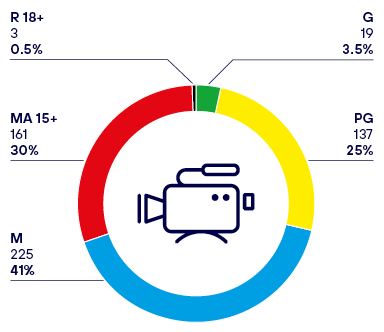
Films classified for sale/hire
The Board made 1,066 decisions in 2023-24, a decrease of 16%, including films submitted as part of the authorised assessor schemes (ACA and ATSA) where the Board is still responsible for the classification of the film, but its decision may be informed by an assessor’s report and recommendation of classification rating and consumer advice. Of note was a significant decrease of 39% in these films classified R 18+, compared with 2022-23.
Table 4: Year on year comparison: Decisions on commercial films classified for sale/hire
| Years | 2022-23 decisions | 2023-24 decisions | ||||
|---|---|---|---|---|---|---|
| Category | Film Other | ACA | ATSA | Film Other | ACA | ATSA |
| G | 167 | 1 | 2 | 115 | 3 | 0 |
| PG | 380 | 37 | 48 | 288 | 14 | 9 |
| M | 285 | 26 | 57 | 298 | 30 | 19 |
| MA 15+ | 212 | 14 | 6 | 213 | 26 | 31 |
| R 18+ | 27 | 2 | 4 | 17 | 3 | 0 |
| RC | 1 | 0 | 0 | 0 | 0 | 0 |
| Total | 1072 | 80 | 117 | 931 | 76 | 59 |
As indicated in Figure 2, 73% of classifications of films for sale/hire during the year were in the advisory categories of G, PG and M, with the highest number of decisions in the M category.
Figure 2: Decisions on commercial films for sale/hire
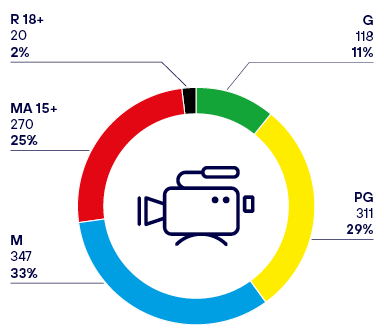
Computer games
The Board made 223 decisions in 2023-24, a decrease of 28% from the previous year, on applications for computer games. The figures include applications made under the Authorised Assessor for Computer Games (AACG) Scheme. Under this scheme, authorised assessors can make a recommendation about classification and consumer advice for a game at the G, PG or M classification levels. The Board is still responsible for the classification of the game, but its decision may be informed by an assessor’s report and recommendation of classification rating and consumer advice.
83% of computer game classifications during the reporting period were in the advisory categories of G, PG and M, with the highest number of decisions falling in the G and PG categories. Of note also was a significant decrease of 49% and 33% in computer games classified M and MA 15+ respectively, compared with 2022-23.
Table 5: Year on year comparison: Decisions on computer games (including AACG)
| Years | 2022-23 decisions | 2023-24 decisions | ||
|---|---|---|---|---|
| Category | Level 2 Gameplay | Assessed Computer Games |
Level 2 Gameplay | Assessed Computer Games |
| G | 60 | 22 | 59 | 10 |
| PG | 54 | 32 | 56 | 13 |
| M | 61 | 29 | 33 | 13 |
| MA 15+ | 40 | 2 | 27 | 1 |
| R 18+ | 10 | 0 | 9 | 0 |
| RC | 0 | 0 | 2 | 0 |
| Total | 225 | 85 | 186 | 37 |
Figure 3: Decisions on computer games (including AACG)
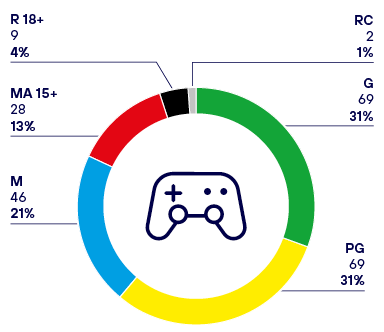
Publications
The Board made 3 decisions on commercial applications for the classification of a publication, two of which were for serial classification declarations that were granted and there were none revoked during this reporting period.
Advertising approvals
The Board did not receive any applications for approval of advertisements under section 29 of the Classification Act.
Advertising assessments
The Advertising Scheme for unclassified films and computer games allows advertising subject to conditions set out in the 2009 Determination.
During the reporting period, the Board made eight assessments of the likely classification of films and no assessments of the likely classification of computer games as opposed to six and none respectively for the previous year.
Table 6: Year on year comparison: Advertising assessments for films
| Years | 2022-23 | 2023-24 |
|---|---|---|
| Category | Likely classification | Likely classification |
| G | 3 | 0 |
| PG | 0 | 4 |
| M | 2 | 2 |
| MA 15+ | 1 | 2 |
| R 18+ | 0 | 0 |
| RC | 0 | 0 |
| Total | 6 | 8 |
Revocations
No decision was made to revoke the classification of a film, computer game, publication or serial declaration under sections 21A, 21AA, 21AB or subsection 13(5) respectively of the Classification Act during this reporting period. Revocations under approved classification tools are discussed in the Approved classification tools section at page 47.
Call-ins
Under the Classification Act, the Director may call-in, that is, issue a notice to the publisher to submit an unclassified film (section 23A), computer game (section 24), or a submittable publication (section 23) for classification. Similar call-in provisions apply in relation to certain advertisements.
The Director did not call in any films, computer games or submittable publications in 2023–24.
Industry self-classification
Approved classification tools
International Age Rating Coalition (IARC)
The Board and its delegates participate in a global monitoring program for the IARC Tool, along with the other rating authorities who use it. The program uses a risk-based approach to target particular content, including first-person shooter games, blood and gore and simulated gambling. This targeted approach results in a higher rate of changed decisions than those randomly selected, providing Australians with greater protection from potentially harmful content.
During the period, the IARC Tool made 387,560 classification decisions, which were published on the NCD. Delegates checked 5,271 games. In addition, the Board checked 55 games to ensure the classification and consumer advice aligned with Board standards before issuing classification certificates. Of these, there were 3,882 revocations (73.6%), with the NCD updated to reflect the new decisions.
Overall, 62.8% of revocations resulted in a higher classification rating, 10.4% resulted in a lower rating, and 26.6% resulted in a change to the consumer advice only.
FIgure 4: IARC Tool decisions
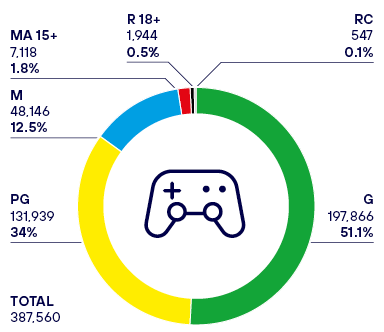
Table 7: Year on year comparison: IARC Tool decisions by rating
| Classification rating | 2022–23 decisions |
2023–24 decisions |
% Difference |
|---|---|---|---|
| G | 206,807 | 197,866 | -4% |
| PG | 26,107 | 131,939 | +405%* |
| M | 57,497 | 48,146 | -16% |
| MA 15+ | 7,752 | 7,118 | -8% |
| R 18+ | 2,294 | 1,944 | -15% |
| RC | 139 | 547 | +294% |
| Total | 300,596 | 387,560 | 29% |
*The launch of the Fortnite storefront in the 2023-24 FY saw an increase in games catered primarily to younger audiences and an increase in PG classification decisions.
Netflix Tool
During the period, the Netflix Tool made 1,252 decisions, which were published on the NCD. The Board checked 54 decisions (4.3%). Of these, the Board revoked 40 (74%), and updated the NCD to reflect the new decisions.
Overall, 17.5% of revocations resulted in a higher classification rating, 20% resulted in a lower rating, and 62.5% resulted in a change to the consumer advice only.
Figure 5: Netflix Tool decisions
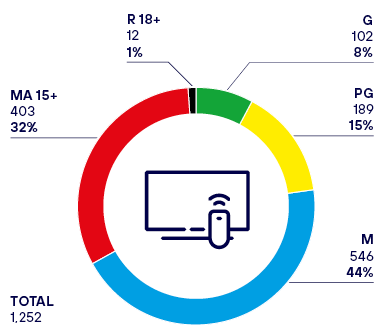
Table 8: Year on year comparison: Netflix Tool decisions by classification
| Classification rating | 2022–2023 decisions |
2023–2024 decisions |
% Difference |
|---|---|---|---|
| G | 165 | 102 | -38% |
| PG | 198 | 189 | -5% |
| M | 583 | 546 | -6% |
| MA 15+ | 463 | 403 | -13% |
| R 18+ | 12 | 12 | 0% |
| RC | 0 | 0 | 0% |
| Total | 1,421 | 1,252 | -12% |
Spherex Tool
During the period, the Spherex Tool made 1,044 decisions, which were published on the NCD. The Board checked 40 decisions (4%). Of these, the Board revoked 25 (62.5%) and updated the NCD to reflect the new decisions.
Overall, 8% of the revocations resulted in a higher classification rating, 32% resulted in a lower classification rating, and 60% resulted in a change to the consumer advice only.
Figure 6: Spherex Tool decisions
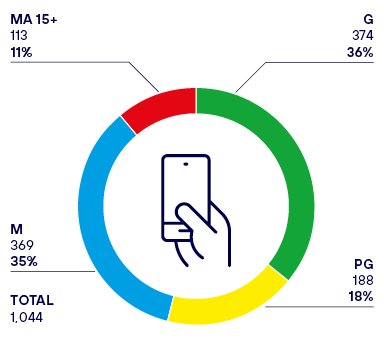
Table 9: Year on year comparison: Spherex Tool decisions by classification
| Classification rating | 2022–2023 decisions |
2023–2024 decisions |
% Difference |
|---|---|---|---|
| G | 128 | 374 | +192% |
| PG | 60 | 188 | +213% |
| M | 213 | 369 | +73% |
| MA 15+ | 40 | 113 | +183% |
| R 18+ | 0 | 0 | 0 |
| RC | 0 | 0 | 0 |
| Total | 441 | 1,044 | +137% |
Board Quality Assurance – Strategic monitoring outcomes
Under section 22CH of the Classification Act, the Board has powers to revoke and replace tool decisions if the Board determines it would have given the content a different classification or consumer advice. The Board monitors tool decisions through checks of tool decisions to ensure they are broadly consistent with Board practices and Australian community standards.
Similar to previous years, the Board’s checks over this period were in response to complaints, media commentary, or the consumer advice containing content of concern to the Australian community. The Board focused on consumer advice that indicated the content contained depictions of, or references to suicide, self-harm, mental health, family violence, sexual violence, blood and gore, and simulated gambling.
To assist tools to produce broadly consistent decisions and provide consistent classification information to Australians, the Board updates the consumer advice list for films and computer games on a regular basis and provides it to tool owners.
Table 10: Year on year comparison: Total Tool checks and revocations
| 2022–23 Total |
2022–23 Number Revoked |
2023–24 Total |
Revoked | % Difference (total number of checks) | |
|---|---|---|---|---|---|
| IARC checks (Delegated) | 3,875 | 2,687 (12% CA only) |
5,271 | 3,855 | +36% |
| IARC checks (Board) | 5 | 3 (33% tool rating too high, 67% tool rating too low) |
55 | 27 | 1000% |
| Netflix checks | 64 | 56 (66% CA only) |
54 | 40 | -16% |
| Spherex checks | 15 | 8 (75% CA only) |
40 | 25 | +167% |
Figure 7: Netflix Tool revocations
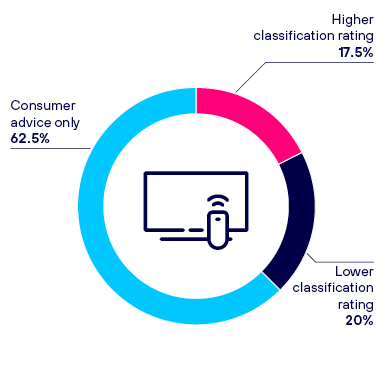
Figure 8: Spherex Tool revocations
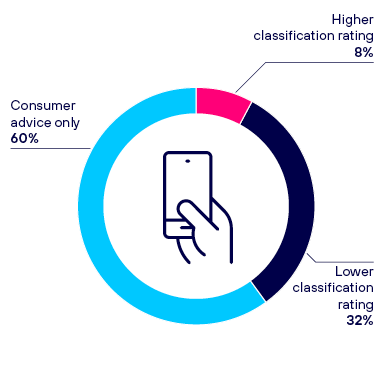
IFIgure 9: ARC Tool revocations
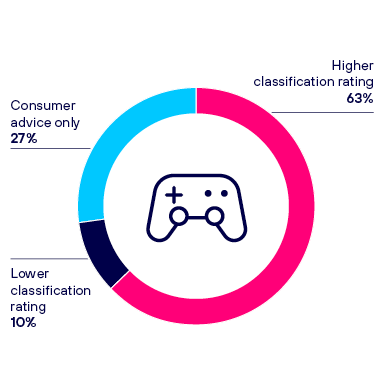
Accredited classifiers decisions
Figure 10: Accredited classifier decisions
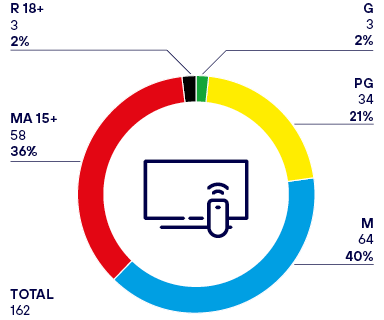
Board Quality Assurance: Strategic monitoring outcomes
The Board monitors the decisions made by accredited classifiers to ensure that decisions are consistent with Board decisions and Australian community standards.
The Board can revoke and replace an accredited classifier’s decision (section 22L) if:
- a different classification should apply
- the decision includes consumer advice not on approved list issued by the Board; or
- the consumer advice is misleading, incorrect or grossly inadequate.
Prior to revoking a classification, the Director of the Board must give notice in writing to the accredited classifier that states the grounds on which the Board is considering revoking the classification and inviting the accredited classifier to make, within 7 days after receiving the notice, a submission as to why the Board should not revoke. If the Board decides to revoke an accredited classifier’s decision, it is required to replace it with a Board decision (section 22L(4)).
Of the 162 accredited classifier decisions, the Board checked 17 decisions (10%). Of these, the Board finalised 11 checks in the reporting period with five revoked, two for classification change and three for consumer advice change - and updated the NCD to reflect the new Board decision.
Table 11: Accredited classifier decisions checked by the Board
| Total number 2023-24 |
|
|---|---|
| Accredited classifier’s decisions | 162 |
| Board checks of decisions finalised | 11 (7% of total decisions) |
| Accredited classifier’s decisions unchanged | 6 (55% of total finalised checks) |
| Accredited classifier’s decisions revoked | 5 (45% of total finalised checks) |
| Revoked due to classification change | 2 (40% of revoked decisions) |
| Revoked due to consumer advice change | 3 (60% of revoked decisions) |
Broadcast notice of classification
FIgure 11: Broadcaster decisions notified to the department by classification
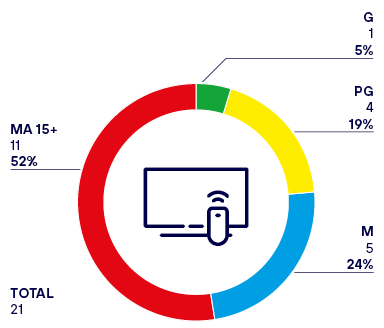
Under the Classification Act, these broadcaster decisions are deemed to be decisions of the Board. The Board is not empowered to revoke these decisions and they are reviewable by the Review Board. In 2023-24, no deemed decisions were reviewed by the Review Board.
Industry Authorised Assessors Scheme
A number of Industry Authorised Assessors schemes have been established to enable authorised industry assessors to submit content with a recommendation for classification. Under the schemes, the Board is deemed responsible for the decision, which is informed by the assessor’s report.
FIgure 12: Authorised Assessor Scheme classification decisions by classification
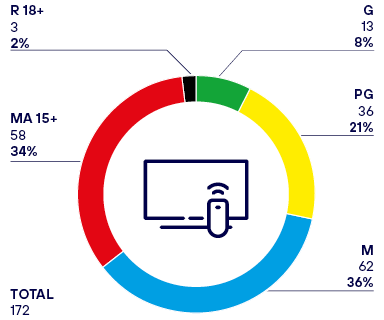
Other functions
Exemptions to show unclassified content
Under the Conditional Cultural Exemption Rules, organisers for events such as film festivals and computer games expos, and for cultural institutions such as art galleries and museums, self-assess their eligibility for exemption to exhibit unclassified films, computer games and certain publications. If they comply with the standard conditions, event organisers can register their event online in the classification portal.
During 2023–24, 350 festival events were registered on the classification portal.
During the reporting period, the Director received 12 applications for a waiver or variation to the exemption rules with a further 4 variations to those exemptions also subsequently granted. Of these, the Director approved all of the applications, with variations in certain circumstances.
Enforcement agencies
There were 28 classification decisions for enforcement applications made in the reporting period. Twenty of these were for publications and eight were for films. There were no enforcement applications for computer games in 2023–24.
All 28 of the enforcement applications required an evidentiary certificate to be issued pursuant to section 87 of the Classification Act describing the action taken or not taken, by the Board in relation to a publication, film or computer game. The total number of documents issued was 56.
| Enforcement agency | Publications | Films | Section 87 certificates | Total documents issued |
|---|---|---|---|---|
| Australian Border Force | 7 | 2 | 9 | 18 |
| Home Affairs | 7 | 0 | 0 | 7 |
| VIC Police | 6 | 0 | 0 | 6 |
| WA Police | 0 | 6 | 0 | 6 |
| Total | 20 | 8 | 9 | 37 |
Decisions
Overview
This section of the Annual Report provides information about the breadth of classification decisions for films, computer games and publications made by the Board during the reporting period.
The decisions referenced are considered noteworthy as they provide insights into the Board’s classification practice and application of the Guidelines. This is done through comparisons of different titles and how they have depicted each of the 6 classifiable elements, at each impact level (G to R 18+).
The 6 classifiable elements in films and computer games are:
- Themes
- Violence
- Sex
- Language
- Drug use
- Nudity
The Classifiable elements in publications are:
- Adult themes
- Violence
- Sex
- Coarse language
- Drug use
- Nudity
The Principles of Context and Impact
When the Board makes a classification decision, the principles of context and impact, noted in the classification guidelines must be considered.
The Importance of Context
The principle of context assists in determining whether a classifiable element is justified by the storyline or themes. In particular, the way in which social issues are dealt with may require a mature or adult perspective. This means that material that falls into a particular classification category in one context may fall outside it in another.
Assessing Impact
There is a hierarchy of impact which relates to each of the classification types. Impact relates to the strength of the effect on the viewer.
The amount of detail shown in the presentation of the classifiable elements is a factor and may mitigate or contribute when determining the impact. Detail relates to the amount of visual/verbal information in the representation of a subject and can include close-ups, repeated visuals/audio, slow motion visuals, resolution, perspective, point of view, size of characters, frequency of depictions and level of realism.
Tone relates to the quality or feel of the material including, but not limited to, its sadness, humour, menace, lightness or seriousness.
Treatment relates to the way in which material is handled or presented. It refers to the artistic handling of a depiction, especially in regard to style. For example, in a realistic treatment, the material may be close to real life and feel authentic, whereas in a stylised treatment, the viewer is conscious of the lack of reality.
The Board notes all of these qualities when viewing content and considers them when making all classification decisions.
Classification marking
Classified material and advertisements for classified material, must display classification markings and consumer advice in accordance with the Classification Act.
The following are the different types of classifications for films in ascending order:
- G General
- PG Parental Guidance
- M Mature
- MA 15+ Mature Accompanied
- R 18+ Restricted
- X 18+ Restricted
- RC Refused Classification.
The following are the different types of classifications for computer games in ascending order:
- G General
- PG Parental Guidance
- M Mature
- MA 15+ Mature Accompanied
- R 18+ Restricted
- RC Refused Classification.
The following are the different types of classifications for publications in ascending order:
- Unrestricted
- Unrestricted M (Mature) Not Recommended for Readers under 15 years
- Category 1 Restricted
- Category 2 Restricted
- RC Refused Classification.
Consumer advice
If a film or computer game is classified by the Board, the Classification Act requires that the Board must determine consumer advice for the classified material. The Board may determine consumer advice for certain publications.
The Board’s general practice when providing consumer advice is to indicate the most impactful classifiable element or elements which caused it to receive the designated classification level, so that consumers can make an informed choice as to whether the content is appropriate for themselves or those in their care, including children and young people.
The consumer advice is usually preceded by a descriptor to indicate impact or intensity, with this descriptor generally corresponding with the hierarchy of impact stated in the Guidelines. The default consumer advice for G-rated films is ‘General’ where there is no content which, in the Board’s opinion, warrants specific consumer advice.
During 2023–24 the Board undertook a review of consumer advice as part of the update of benchmarks and standards. The Board continues to provide consumer advice for the presence of issues of community concern which are at the most impactful level, or if they are pervasive, or at the upper limit, one level below the most impactful classification. This is the case for consumer advice relating to self-harm, suicide, sexual violence, mental health themes, child sexual abuse and family violence.
The Board also reviewed and updated its consumer advice specifically related to computer games, setting new standards for the application of legislation that comes into effect on 22 September 2024. The legislation requires minimum mandatory classifications for games containing loot boxes and simulated gambling – these being chance-based in-game purchases and simulated gambling respectively. To accommodate content that does not meet the strict definition of simulated gambling in the legislation, the Board will use consumer advice of Gambling themes applicable at any impact level G to R 18+ to note thematic content related to gambling type environments, experiences and/or mechanics.

Films
The following examples and statistics about film relate solely to those decisions made by the Classification Board and exclude those made by classification tools (Netflix and Spherex, accredited classifiers and broadcast television notices of classification).

G – General
The impact of the classifiable elements for material classified G should be very mild only.
The G classification is for a general audience. However, it does not necessarily indicate that children will enjoy the film. Some G films contain themes or storylines that do not interest children.
If there are no classifiable elements present, the consumer advice applied by the Board will be General.
Out of the total of 1,611 commercial films classified during the reporting period, 137 were classified G. Notable decisions include:
Both Peppa’s Cinema Party - General and Salt of the Earth - General are classified G. Peppa’s Cinema Party is a sing-along with the extroverted preschool pig, while Salt of the Earth is a documentary about the Australian inventor of chicken salt. While the latter is interesting, it is unlikely to spark the interest of very young children. A G classification marking signifies that the content has no classifiable elements present, it does not necessarily mean that the content is suitable for children. To that effect, if there are classifiable elements present, the Board always notes the most impactful elements in the consumer advice so the Australian audience - and particularly parents and guardians - can make an informed decision before the content is viewed, as illustrated in the next example.
Il Cerchio - Very mild themes, is also classified G. However, due to its depiction of themes such as discrimination, bullying and family dysfunction, this film warranted consumer advice to inform audiences that the content is more challenging than the sing-along with Peppa Pig or the story of the chicken salt inventor. Yet, it still fits within the G category because the themes are dealt with in a caring and gentle manner, with a focus on self-acceptance and emotional inclusivity. These themes are also mitigated by the fact that they are entirely verbal and placed within a documentary context.
Treatment and context are key factors in classification decisions.
For any films rated G General, additional information is available on the NCD via the Australian Classification website. Under “More information about the content of this film”, the elements present in a film are noted and described in more detail than in consumer advice.
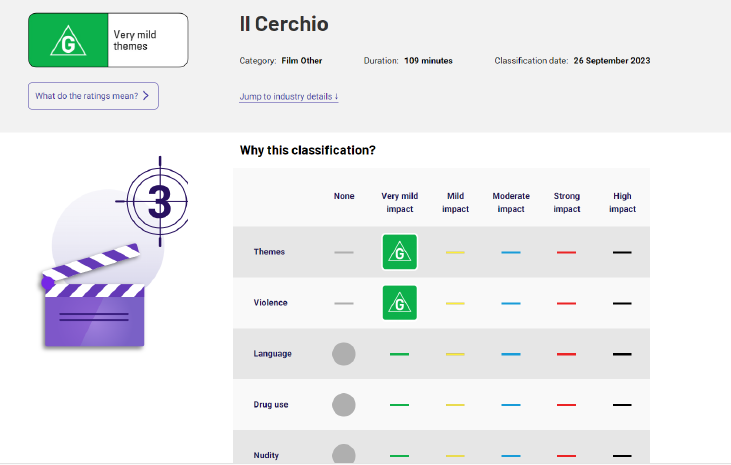
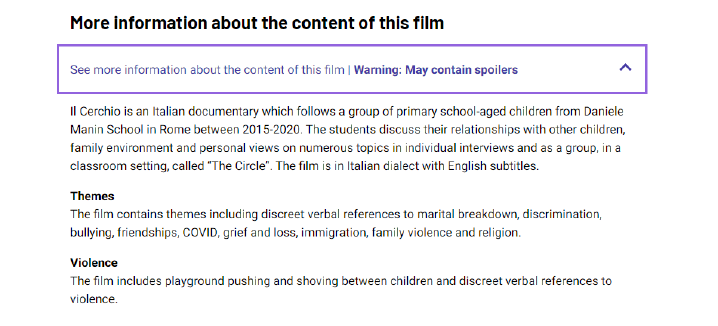
In this particular film, it is noted above that references to violence are present in the form of playground shoving and pushing as well as verbal references, but were subtle enough not to warrant noting in the consumer advice.
Violence is, however, often a key concern for parents so it is a theme the Board pays particular attention to at lower impact levels and for content focused on children or family audiences. The Guidelines state that violence should be very mild with the Board standards noting it should be limited to infrequent and very discreet references as in the above example, or limited to the threat of violence, if in a realistic context. Shoving, pushing and slapping is accommodated by the Board’s standards at the G level when it happens in a slapstick manner between anthropomorphic or cartoon-like characters or within a playful context.
The Garfield Movie - Very mild themes, slapstick violence and infrequent coarse language. This is a great example of this genre of violence. The well-known lazy, cynical and self-absorbed orange Persian cat is trained by a bull Otto, who repeatedly hits Garfield, his dad and Odie, with sound effects and cartoonish, exaggerated impact. One particular scene features Garfield pestering Otto, who is sitting in a meditation position. Otto suddenly punches him in a deadpan fashion which causes Garfield to fly through the air and crash into a tree trunk. The scene cuts to a shot of Garfield collapsed by the tree looking dazed and with a few teeth missing, but Garfield is healed in the next shot. The film exemplifies the importance of considering tone and treatment in classification decisions. Although there are moments of violence, threat and action, the overall tone is comedic and light-hearted throughout, even during those scenes. Overall, the emphasis is on the collaboration and sense of camaraderie between the characters. The prevalent and almost constant humour frames the overall violence within the slapstick genre, mitigating its impact. Additionally, the animation is rendered in an accessible and playful style, which adds humour and lightness to the scenes. As such, the thematic content was accommodated within a G classification with consumer advice of very mild themes, slapstick violence and infrequent coarse language best describing the most impactful content.
By contrast, the depictions of scary scenes in Migration - Very mild themes, some scenes may scare very young children - warranted some additional consumer advice. In this animated film, a mallard family is on its way to tropical Jamaica. They have just freed Delroy, a homesick Jamaican-accented parrot locked away in a Manhattan restaurant, who has escaped from the New York chef who held him captive. After discovering a trap underground in a nearby forest, they land in a farm that looks like a duck paradise, led by yogic leader Googoo. While the family is making the most of the facility, Dax, the mallard son, sees the New York chef’s truck parked outside. All the ducks are invited inside the truck for a “field trip”.
Dax realises that the ducks are headed for the chef’s kitchen. He is determined to rescue them all. As Dax tries to rescue them, the chef walks over to him, crushing his wings and ripping some feathers off under the sole of his foot. He then pins Dax to the ground with his giant kitchen fork. Dax is stuck underneath while the chef takes out his kitchen knife. For a brief moment, the sense of danger is heightened by the accompanying music, but within seconds, the ducks understand that they need to get off the truck, and all at once they rush out, knocking the chef off his feet. All the ducks then fly away together.
In the Board’s opinion, although the scenes described included a sense of peril, due to the light-hearted, comedic tone, positive resolution and the focus on the resourcefulness of the mallards and their friends, the impact is no greater than very mild. As such, the film warrants a consumer advice of very mild themes with additional consumer advice of ‘some scenes may scare very young children best describing the most impactful content of the film.
Other content that often warrants a G classification includes concerts, such as Mariah Carey: Merry Christmas To All! - General or Cliff Richard: The Blue Sapphire Tour 2023 - General, as well as documentaries such as Inside the Dream - General about the House of Dior or Maria Callas: Paris 1958. Also, in this category are instructional film series like Citadel Colour Masterclass - Very Mild themes: which demonstrate how to paint Warhammer figurines.

PG – Parental Guidance
The impact of the classifiable elements for material classified PG should be no higher than mild.
Material classified PG may contain material which some children find confusing or upsetting, and may require the guidance of parents or guardians. It is not recommended for viewing by persons under 15 without guidance from parents or guardians.
Out of the total of 1,611 commercial films classified in 2023–24, 448 were classified PG. Notable decisions include:
Inside Out 2 - Mild themes, is a perfect example of what audiences may expect to find in the PG category. It contains themes related to adolescence, anxiety, self-doubt and friendship in the context of a teen girl entering puberty and meeting new friends. It is, compared to a G rated film, emotionally charged and depicts difficult subject matter, but always with an uplifting tone and positive outcomes. The difficult subject matter is further mitigated by the highly stylised animation and cartoonish characters reacting in a slapstick manner during their adventures.
Less expected would be Corrie Ten Boom’s The Hiding Place - Holocaust themes, in which Corrie Ten Boom and her family risk everything to hide Jewish refugees by the hundreds, and ultimately face the consequences when they are discovered. This exact story-line could have warranted an M had it not been depicted as a stage production filmed for the big screen. Once again, context is key. It is crucial in determining whether a classifiable element is justified by the story-line or themes. In particular, the way in which important social issues are dealt with may require a mature or adult perspective.
This means that material that falls into a particular classification category in one context may fall outside it in another as is the case with this film. In this instance, the theatrical presentation of the Holocaust themes, with the majority of references being verbal or delivered in impressionistic sequences, mitigates the overall thematic content, which did not exceed a mild impact overall. The classification guidelines state that material classified PG may contain material that some children find confusing or upsetting, and may require the guidance of parents or guardians. This appropriately describes this content, which can be accommodated within the PG classification with the consumer advice of Holocaust themes best describing the most impactful content.
The PG classification requires that the treatment of the themes or any other element is discreet, and for this specific theme (the Holocaust), without visual depictions, to remain within a mild impact. Parental Guidance implies Australian parents and guardians, rather than the Board, can decide if it is appropriate or not for those in their care to watch.
How to Make Millions Before Grandma Dies - Mild themes and coarse language, is another great example of a film rated PG due to its discreet treatment of complex and emotionally laden themes. It is a Thai film in which a young man decides to care for his dying grandmother, motivated by her fortune, in the hope to win her favour before she passes. But the more time they spend together, the more their bond strengthens beyond expectations.
The film contains themes of terminal illness and bereavement, as well as a couple of (very brief) emotionally charged scenes. The film does, however, depict the events in a positive light and with a focus on the beauty and simplicity of the bonds between the characters, no matter the circumstances. It is exactly what a discreet treatment allows; dealing with difficult matters such as terminal illness and death while not exceeding what can be accommodated within the PG classification.
Death is also present in supernatural elements in the form of ghosts or supernatural entities. An example are those found in the Indian romantic comedy Kade Dade Diyan Kade Pote Diyan - Mild supernatural themes: where lovers have to help deceased grandparents who reappear as ghosts to find peace that would allow their own relationship to be accepted by both families. Ghosts are also depicted in PG films in many forms, including as scary monsters in Haunted Mansion - Mild supernatural themes, violence and coarse language, some scenes may scare young children: This is a supernatural comedy inspired by the classic Disney theme-park attraction. It tells the story of Gabbie, a single mom, who hires a tour guide, a psychic, a priest and a historian to help exorcise her newly bought mansion after discovering it is inhabited by ghosts. In Kade Dade Diyan Kade Pote Diyan, ghosts are depicted as ‘normal’ human beings whom only one or two characters can see. In contrast, Haunted Mansion presents ghost-like shapes and forms that may scare young children and contains a tone which gives a mild, yet pervasive sense of threat and menace.
The difference in treatment - one where ghosts are solely used as a comical element within the narrative, the other where they are used as both a comical and a scary device, explains the difference in consumer advice even though they are both rated PG. In the Board’s view, Haunted Mansion warranted an additional consumer advice of ‘some scenes may scare young children’ with the intent to alert parents and guardians that while this is a PG fantasy film there are scary elements. The Board’s role is to classify content and thereby enable adults to make an informed decision, based on their own contexts and their children’s tastes, experiences and personalities.
The remake of Mean Girls - Mild themes, sexual references and coarse language: pushes the upper limit of what can be accommodated in PG and yet, does not warrant an M classification. The musical comedy film in which new high school student Cady Heron is welcomed into an elite clique of popular girls called ‘The Plastics’, is targeted at a very specific audience - a generation of teens that grew up with social media.
While still clearly addressing coming-of-age issues, the film contains frequent yet discretely implied sexual activity, verbal and visual sexual references and instances of sexualised imagery that are justified by context and can therefore be accommodated at the mild impact level according to the Guidelines. Their depiction has a more heightened tone than a ‘typical’ PG film, which reflects the updating of the film to today’s high school generation. Coarse language is frequent and includes the bleeping out of what are clearly words that would typically be classified M but due to them being obscured, can also be accommodated at PG. Overall, the Board debated the impact of the content and acknowledged its impact is at the upper limit of the PG classification. The musical and comedic treatment of themes saved the film from being classified M. The presence of crude humour, sexual references and sexualised imagery pushing the upper limit of the PG rating is a trend the Board is closely monitoring.

M – Mature
The impact of the classifiable elements for material classified M should be no higher than moderate.
Material classified M is not recommended for persons under 15 years of age. There are no legal restrictions on access.
Out of the total of 1,611 commercial films classified in 2023–24, 572 were classified M. Notable decisions include:
One of the more common elements to identify in the M classification is that of coarse language. The Board has an indicative standard for frequently used words which constitute coarse language, the use of which usually guarantees an M classification. Taylor Swift: The Eras Tour - Coarse language: is a U.S. film of the 2023-24 concert tour called Eras by singer-songwriter Taylor Swift. Swift’s songs include themes related to relationships, relationship breakdowns, the patriarchy and internal struggles which when presented in this context are of mild impact. However, it was the use of coarse language in several song lyrics that presented a moderate impact and resulted in the M classification and consumer advice of coarse language.
Another example is Past Lives - Coarse language: Past lives is a drama film in which childhood sweethearts reunite in New York two decades after one emigrated from South Korea. They take stock of the choices they have made in the intervening years. The themes of love, of past choices and their consequences are treated in a gentle, melancholy tone such that if themes were the most impactful element the film would be classified PG. However, as was the case with Taylor Swift: The Eras Tour, use of moderate coarse language was also present and required that the film be classified M.
M classification is category where the content depicted requires a mature perspective. It is not a legally restricted category but it is also not recommended for persons under the age of 15 years. This implicitly acknowledges that parents are best positioned to assess their children’s maturity and what they deem acceptable content within the boundaries of the M classification.
The Guidelines also allow for moderate violence at the M classification, which, applied using current Board standards, requires no emphasis on blood or injury detail. The depiction of violence comes in many different forms and consequently it is one of the few elements that the Board’s standards differentiate into different types. These types include live action or animation, realistic or in the context of a specific genres such as science fiction, horror, fantasy or supernatural. At a moderate impact level, it is most often implied and not directly depicted on screen, with limited blood and injury detail and often obscured by camera angles or body positions (though in the audience’s mind this violence is often very visible).
Violence which tends to be realistic is regularly present in drama or thriller films, such as in The Goldfinger – Violence: a Chinese crime drama which follows the Hong Kong Independent Commission Against Corruption and its attempts to unravel the corrupt dealings of a syndicate during the 1980s. The film contains occasional, realistic violence with the use of guns, vehicles and hand-to-hand combat with accompanying blood detail and minor injury detail.
Conversely, violence can also be depicted in a highly choregraphed and stylised form, often with a lot of casualties, mostly without any blood detail and limited post-action visuals. Typically, depictions incorporate frequent and extended hand-to-hand combat or gunshot sequences with victims falling to the ground without any visible injuries, except their immobility implying they are dead. Board standards designate this as action violence and it is demonstrated in the film Meg 2: The Trench - Sustained threat and action violence: This is an action thriller in which Jonas leads a research team on an exploratory dive into the deepest depths of the ocean and fights a megalodon, (giant prehistoric shark), as well as a group of heavily armed mercenaries. The film contains action violence that includes the use of guns, harpoons, explosions and hand-to-hand combat, as well as animal attacks. There is very little blood or injury detail, to the point that, (spoiler alert), even the dog on the poster survives. However, the sense of threat is also pervasive throughout the film and warranted additional consumer advice for those who do or do not, like to have their palms sweaty.
The treatment of violence when highly stylised within the context of an animated film can also contribute to its impact, such as in One Piece Collection 60 - Animated violence: A Japanese fantasy series in which a group of pirates pursues the elusive treasure of the now dead pirate king, Gold Roger. The series typically oscillates between the PG and M classifications, but generally includes highly stylised blood spray and splatter effects that impart a moderate impact. Of course, if these depictions were live action, rather than animated they would most likely exceed a moderate impact and warrant an MA 15+ classification.
Another type of genre modifier that contextualises violence in consumer advice for an audience can be found in Rocky Balboa (Director’s Cut) - Sporting violence: A drama film in which Rocky Balboa comes out of retirement and returns to the ring for an exhibition fight against the reigning heavyweight champ, Mason ‘The Line’ Dixon. In this film, the violence only occurs within the defined limits of a sport with limited blood and injury detail occurring within a boxing match. In terms of treatment and thus impact, this is different from that of an unexpected bare-knuckle street fight.
Other types of violence can be defined by the genre in which they are encountered, and some of these contexts can potentially mitigate or heighten its impact, such as comedic violence as opposed to horror violence. At times, both can be present within the same film, like in the Norwegian comedy horror film There’s Something in the Barn - Horror violence and coarse language: in which an American family must defend their new home in Norway against a disgruntled, ancient barn elf. The violence depicted occurs within a horror context but is also mitigated by its pervasive comedic tone throughout. The film features several jump scares along with examples of unsettling imagery as characters are menaced by sinister fantasy beings. The fantasy beings - folkloric elves - cause havoc and seek to inflict revenge on the humans for disturbing their home, resulting in numerous acts of violence. Much of the most impactful violence takes place off-screen or in dark and/or visually murky environments, in which detail is often indistinct. In most instances character reactions and the use of the soundtrack, rather than explicit visual depictions of violence, generate the greater shocks and impact. That impact is consistently mitigated by the deliberately broad comedic tone and highly stylised treatment enabling the content to be accommodated at an M classification.
A final example of violence worth noting can be found in the Ugandan documentary film Once Upon A Time in Uganda - Comedic violence and coarse language: This film is about the growing action film industry in that country. In one scene actors are auditioning against a green screen. A balloon filled with a red liquid is placed inside a man’s shirt. He is then “shot” and “blood” bursts from his torso. These are clearly achieved through the use of special effects and props, and the actors, crew and bystanders are laughing and jovial at the scenes being played out. Overall, despite the numerous scenes of violence and the presence of blood detail, the impact of the violence is moderate as it is significantly mitigated by the film’s documentary context, as well as the comedic positive tone and use of exaggeration throughout.
Once again, treatment and thus the context of the depiction of classifiable elements underpins all Board decision-making. For instance, in contrast to Corrie Ten Boom’s The Hiding Place, The Zone of Interest, Holocaust themes: does sensitively and discreetly depict the same subject matter and themes, but utilises a treatment that is tonally stark and in the Board’s view requires a more mature perspective. It is an historical drama film in which the commandant of Auschwitz, Rudolph Höss and his wife, Hedwig, strive to build a dream life for their family in a house and garden next to the camp. The film contains off-screen implied violence that is audible at various points throughout the film, which includes the sounds of screaming, gunshots and sirens as well as visuals of billowing smoke and flames emanating from the chimneys of Auschwitz. What remains constant is the impact generated for the audience knowing what is happening in the background without directly seeing it, much like the family itself.
Another film of note from the last year requiring a mature perspective is Shayda, Mature themes: An Australian drama film which depicts the impact of domestic violence upon a family who have recently migrated from Iran. In this case the themes of domestic violence, coercive control, family separation and family breakdown are depicted in such a realistic manner that it exceeds a mild impact. Warranting an M classification, the consumer advice mature themes is used to indicate the mix of themes depicted and that there are a range of related themes, at the most impactful level being moderate.
Of course, some films most impactful themes are very specific and more easily identifiable, such as in Do No Harm, Mental health themes and suicide references: A documentary film which looks at chronic rates of depression and suicide in medical doctors and students. It follows the efforts of a few who are trying to effect change across the health care system, government and medical schools across the United States. The documentary was rated M for its moderate impact in dealing with the pervasive themes of mental health issues and suicide.
At times, themes and violence are very closely intertwined, and some films can also feature two distinct forms of harm that take their toll on people. Fight to Live, Themes of abuse, sporting violence and coarse language: depicts themes of psychological abuse and coercive control, and sporting violence in the form of combat sports fighting. The film is an Australian documentary about Bec Rawlings, which follows her inspiring journey as a professional fighter and survivor of family violence perpetrated by her partner.
Some films require us to provide bespoke consumer advice so that we can do justice to the content and keep audiences best informed. This was the case of Gaami, Human experimentation and sustained threat: An Indian film with a narrative structure split between three characters and timelines. The main narrative thread is, in the Board’s view best described by the consumer advice. In discussing the decision and proposed consumer advice, the Board’s view was that mature themes felt inadequate and inappropriate, which led to the bespoke advice.
A consumer advice of mature themes is often more harmonious and relevant for dramatic films. This includes, for example, films that depict difficult relationships and/or circumstances in combination with other impactful elements which together require a mature perspective. This is the case with Blue Jean, Mature themes, coarse language, sex and nudity: This drama film is set in England in 1988 and tells the story of Jean, a closeted gym teacher, who struggles with her double life as a new series of laws stigmatise gays and lesbians.
The film contains themes of discrimination and homophobia, including the use of aggressive derogatory terms and depicts the emotional toll on the main character. References are made to historical legislation which prohibited homosexuality, all of which is captured within mature themes. The film also contains implied sex scenes, which at this classification level, are required to be brief, undetailed depictions.
The sex scenes are brief, implied and include limited movements and sounds, mainly in darkly lit environments, in mid-frame shots with partly obscured nudity, all mitigating factors. It is this treatment of the elements of sex and nudity in particular, that imparted an impact no greater than moderate, and the film being accommodated at an M classification.
The element of sex can also be present at M in the form of sexual references, either verbal of visual, along with the use of coarse language and sexualised imagery which when combined can be defined as crude sexual humour. All of these elements are depicted in the film Back on the Strip, Crude sexual humour, sexualised imagery and coarse language: a U.S. comedy film in which a young man, Blaze, moves to Las Vegas to pursue his dream of being a magician, only to end up joining a male stripper group.
The film contains sexualised imagery in the form of erotic dances and sexual references including the use of coarse language in a sexual context. In one scene, Merlin does his last dance performance at the club for the night. Fully clothed, he starts with a series of sexualised dance moves, including thrusting his hips and humping the stage floor as the female audience cheers and throws cash at him. After removing his shirt, he rips off his Velcro trousers to reveal that he is wearing underpants with an exaggerated, prosthetically oversized crotch. Verna narrates, “And for Merlin there was only one choice – go big!” Overall, the film’s treatment of crude sexual humour, sexual references and sexualised imagery is not prolonged, does not depict any nudity, and is presented in a light-hearted, comedic context, in line with the Board’s standards to be accommodated at an M classification.
The Guidelines define sexual violence as “Sexual assault or aggression, in which the victim does not consent”. As with other issues of community concern, the Board is committed to including consumer advice for sexual violence whenever present at the classification level or at the upper limit of one below. At the M classification level such depictions must be implied, very brief and most typically present as verbal or visual references.
An example is the Indian drama film Neru, References to sexual violence: A young blind woman who has been raped seeks justice through the legal system. A scene noted by the Board depicts an extended flashback to the implied rape. Within it there is a brief implied depiction of sexual violence, yet in the Board’s view it was the most impactful element within the film and thus warranted specific consumer advice. In line with the Board’s standards, any visual depiction of sexual violence that is extended in duration, showing the wider scene, and full bodies with movement, typically heighten the impact to strong and warrant an MA 15+ classification with a consumer advice of strong sexual violence. In fact, in some films the context of an implied depiction with a particularly impactful treatment, can exceed a moderate impact and warrant a higher classification as the next decisions will illustrate.

MA 15+ (Mature Accompanied)
The impact of material classified MA 15+ should be no higher than strong.
Material classified MA 15+ is considered unsuitable for persons under 15 years of age. It is a legally restricted category.
Out of the total of 1,611 commercial films classified in 2023–24, 431 were classified MA 15+. Notable decisions include:
Palm Trees and Power Lines, Strong themes of abuse and sexual violence: is a drama film that follows Lea, a disconnected seventeen-year-old girl, who falls in love with a seemingly kind man, Tom, who is twice her age. The film discreetly depicts its themes of coercive control and abuse in the form of a man using deceit and emotional control to groom a seventeen-year-old girl for prostitution. The cumulative effect on the main character and impact on the viewer were considered by the Board to exceed a moderate impact, tipping into strong. The film also contains themes of family dysfunction, as well as visual and verbal references to a sexual relationship. The sexual violence in the film is not explicit, yet pervasive and insidious.
The focus of the story is not the girl’s age, but her fragility, her need for attention and her loneliness, which allow her to be groomed by an older man. The emphasis for the majority of the film remains on the subtle coercion and control rather than explicit depictions of physical abuse. There is a complete absence of nudity during the sexual activity between characters. In the Board’s opinion, despite the controversial and confronting subject matter, the treatment and depiction of this thematically complex material did not exceed a strong impact.
When films have a group of impactful themes that cannot be easily differentiated in consumer advice, the Board will sum up this group by using strong themes, as was the case with Civil War, Strong themes and violence: In this drama film, a small team of military-embedded journalists and photographers embark on a dangerous trip to Washington DC to interview the President during the height of a modern American civil war. The film contains themes related to war, a pervasive sense of threat, death, post-traumatic stress disorder and political unrest, with some accompanying blood and injury detail. It also contains visual references to a massacre and immolation, all treated in a realistic, tense tone.
The violence is conveyed using a mix of top-down aerial shots and close-ups with an occasional shaky-cam effect, intercut with still images shot from the war photographers’ cameras, much like audiences are accustomed to in modern media accounts on conflict. At times, upbeat or sombre songs play over the action, heightening the impact of the scene. A large-scale frenetic and fast-paced night battle takes place between the government army and separatist Western Forces, which features incessant gunfire (land-based and from helicopters), along with large explosions and tank fire. The realism of the film’s depictions and its pertinence to contemporary American political issues, imparted a strong impact.
Strong themes in a consumer advice is an indication that the content may contain challenging material.
The Director Yorgos Lanthimos, never shying away from creating discomfort for audiences, often presents complex, and thematically layered films, that do just that, as in the film Kinds of Kindness, Strong themes, violence, sexual violence and sex scenes: This UK drama film features three separate stories – one following a man who is subservient to his boss to frightening extremes; one following a man who is suspicious that his wife, returned from being lost at sea, is not really his wife; and one following a woman’s quest to find a prodigious spiritual leader. All of these stories are underpinned by a pervasive and often insidious sense of unease that is heightened by the film’s unsettling and discordant music score, which frequently includes the foreboding use of a single, haunting piano note.
In regard to the film’s depictions of both violence and sexual violence, the Board noted that many of the scenes involve implicit and post-action depictions rather than explicitly depicting the acts of violence themselves. The post-action visuals do, however, include clearly visible blood and injury detail that in, and of themselves are no higher than a strong impact, which in the Board’s standards incorporates dismemberment, frequent injury detail and copious blood detail. While the film is at times visceral in its impact, it is also morally and intellectually testing, which creates arguably as much impact for audiences.
At times, most of the violence in a film can be discreet, with implied action and without depictions of points of impact and limited injury detail. Some violence however, is depicted with frequent and abundant blood detail, without viewing the injury that that can be defined as the most impactful element at an MA 15+ classification. In this case, the consumer advice, much like the earlier noted genres of violence, identifies the treatment of the violence as ‘bloody’. Monkey Man, Strong bloody violence: One such example, is an action thriller that follows a young man who unleashes a campaign of vengeance against the corrupt leaders who murdered his mother. The film contains extended scenes of action violence, with melee combat and frequent examples of choreographed martial arts-style fighting, as well as combat with weapons such as guns, knives, sticks, and other objects.
Bloody violence is at times confused with violence that includes blood and gore, which is in fact quite distinct, as the latter most typically depicts bloody injury detail, dismemberments or frequent viscera. A perfect example is Sisu, Strong violence, blood and gore: A Finnish action film set in 1944 in which a gold miner, Aatami, fights off Nazis to defend his gold acquired by mining. In an early sequence, one of the Nazis is sent to explore the fog where Aatami is hiding after a massive explosion. The soldier walks slowly throw the fog when a landmine flies through the air and hits him in the head. His body disintegrates in a balloon-style explosion. Nazi soldiers are sent again and again to traverse the mine-riddled ground with the same result, in what becomes a farcical, and somewhat darkly comedic extended scene. Throughout the film, pronounced injury detail of this nature is depicted as the action unfolds. Clearly, for the Board, consumer advice that included blood and gore was the most appropriate additional description for the most impactful form of violence, particularly as it was frequent.
When the film contains violence which includes infrequent yet extended, detailed and/or realistic depictions of injury detail, both are included in the consumer advice as in the film for Furiosa: A Mad Max Saga, Strong violence and injury detail: follows the journey of Furiosa in an apocalyptic wasteland where resources are preciously guarded. A key scene depicts Furiosa extending her arm from the window with a gun, and Dementus’ vehicle rams into hers, pinning her arm as blood sprays. In a later scene, after chaining Furiosa to his vehicle by her injured arm, Dementus sits in the cab of his truck and Furiosa is unseen behind the truck. Having resolved his thoughts, Dementus returns to confront Furiosa, and through the dusty haze, the camera focuses on her severed arm dripping glossy red blood and dangling sinew from the end of the chain. It is implied that she has torn her own arm off at the injury site to escape. Later, the raw, bloody stump of Furiosa’s arm is depicted in close-up with maggots crawling over it, as she awakes in a cave surrounded by hanging body parts and pieces of flesh being scraped of maggots, along with piled bodies. Injury detail, when limited and briefly depicted, can be accommodated as part of post-action visuals of violence. However, with the contributing factors of depictions focusing on the injury and with detail, frequently, as is the case here, the impact increases to that of strong requiring additional consumer advice.
Another strong impact defining depiction at an MA 15+ classification is the detailed preparation or use of illicit (proscribed) drugs and their effects, as is the case in Peter Doherty: Stranger in my Own Skin, Strong drug use and coarse language: A documentary film that follows British musician Pete Doherty’s journey through opioid addiction, recovery and relapse. Doherty’s journey is captured in personal interviews and home movies filmed over a period of 10 years. The film contains frequent verbal and visual depictions of drug use and drug references related to heroin and other illicit substances.
Early on in the film, a rock song plays as the camera zooms in on a spoon, out of focus. The camera sharpens, revealing a blackened spoon and a syringe inserted into a brown cotton ball. The plunger is pulled back as it draws up the brown liquid into the syringe. The camera cuts to a close-up of a bicep being tied off with a black tourniquet. It moves to a close-up of Doherty’s clenched fist and a tied tourniquet around his arm, then to a close-up of Doherty’s face who is looking down at his raised arm where it is implied he is injecting himself with the drug. The detailed preparation is enough to warrant an MA 15+ classification, and so is the use of frequent strong coarse language.
Another strong impact defining feature of this classification level can be illustrated through the element of sex and in particular sexual activity or sex scenes that include depictions of simulated sexual fetish or kink such as BDSM or bondage, as well as implied but extended and/or detailed scenes. A marker for strong impact within sex scenes is most typically the depiction of thrusting movements. This was the case with Le Temps d’Aimer, Strong sex scenes: A French drama film in which a hotel waitress, Madeleine, meets a rich student, François, and follows the couple through their lives together in the following decades. The film contains numerous implied sex scenes with buttocks, thrusting and breast nudity.

R 18+ (RESTRICTED)
The impact of material classified R 18+ should not exceed high.
Material classified R 18+ is legally restricted to adults. Some material classified R 18+ may be offensive to sections of the adult community.
Out of the total of 1,611 commercial films classified in 2023–24, 23 were classified R 18+. Notable decisions include:
KamiKatsu: Working For God In a Godless World (The Complete Season), High impact sexual themes and sexualised imagery: is a Japanese anime series that follows Yukito, who is reincarnated into a world without religion where life and death are dictated by the Imperial State, and is subsequently rescued by the goddess Mitama to form their own religion. The series contains fantasy and sexual themes such as exploitation, ritual sacrifice, self-sacrifice, suicide, cultism, religion and reincarnation. The pervasive tone is overtly sexual and the depiction of characters frequently sexualised. The series frequently features the female form, often in conjunction with highly revealing clothing with a focus on body positions and framing that emphasise cleavage. There are numerous lingering close-up shots of oversized breasts and crotches that focus on implied genital mounds intended primarily to titillate, pushing the overall content to a high impact level despite the stylised animation.
By contrast, Rotting in the Sun, Actual sexual activity: This film depicts sexual activity that is so realistic it is easily interpreted by audiences as actual and is defined as thus by the Board’s standards. In this comedy-thriller film, depressed artist Sebastián Silva decides to collaborate with Jordan Firstman, a social media influencer he meets on a nudist beach in Mexico. The film contains realistically simulated and actual sexual activity in the form of anal sex, fellatio and use of sex toys. In the Board’s opinion, the depiction of realistically simulated and actual sexual activity is justified contextually within the context of the film’s narrative, which mitigates it, and the film does not meet the threshold for X 18+ content. The scenes are not prolonged, or detailed, and are not gratuitous or exploitative. Furthermore, they are depicted in a manner that conveys a sense of ‘everyday’ realism reflective of the characters’ lifestyles. In the Board’s view the film did not exceed a high impact and could be accommodated within the classification of R 18+.
More expected films in this category are found in the horror genre, with films such as Winnie the Pooh: Blood and Honey 2, High impact horror violence: The film features pervasive scenes in which assorted weapons are used to kill multiple people by dismemberment, stabbing and decapitation, accompanied by significant injury detail, occasional liberal depictions of blood and gore, along with physical deforming. The extended depictions of violence, while in context within the horror narrative are intended to frighten and disgust, and impart a high impact, that also warranted consumer advice qualifying the genre of violence depicted with the “horror” modifier.
Bastar: The Naxal Story, High impact violence and injury detail: is an Indian dramatic film about the Naxalite-Maoist insurgency in the Bastar district of Chhattisgarh, India. It is another, albeit very distinct example, of high impact violence. In the film, the violence is infrequent but highly realistic, graphic and detailed including a 3-minute-long execution scene with blood and injury detail.
At times in films, filming of a theatre production can be a significant mitigating factor to lessen the impact of some content. In the case of A Little Life, High impact themes, self-harm, sexual violence, references to child sexual abuse and suicide: The stage adaptation of the best-selling novel filmed entirely as a live performance of the theatrical play. A significant contributing factor was depictions using multiple cameras both from the audience perspective, and on and above the stage itself.
The narrative follows a group of friends in New York City, as they embark on their own careers with ambition and hopes for the future. Jude, their friend who is a prestigious lawyer, holds a secret that is slowly revealed, in which he was repeatedly exposed to sexual and emotional abuse as a young child at the hands of a monk, Brother Luke, which has left him with physical injuries and complex mental health issues. The film tracks his journey through interactions with friends and health professionals, including numerous depictions of self-harm. The descriptions and depictions of events are told through Jude’s inner monologue and characters from the past and present that appear on stage, often narrating together, as scenes play out. In the Board’s opinion, the elements of themes and violence within the context of this film, despite being depicted as part of a live stage play with an audience present, are heightened by the depictions of self-harm with associated blood detail and graphic descriptions of child abuse, references to suicide and post-action visuals. As such they impart a cumulative impact that exceeds what can be accommodated at an MA 15+ classification. The film warranted an R 18+ classification.

X 18+ (RESTRICTED)
The X 18+ classification applies to films only. It is a special and legally restricted category which contains only sexually explicit material: that is, material which contains real depictions of actual sexual intercourse and other sexual activity between consenting adults. X 18+ films are restricted to adults 18 years and over. These films can only be legally sold or hired in the Australian Capital Territory and parts of the Northern Territory.
Films classified X 18+ can contain real depictions of actual sexual activity between consenting adults, but the classification does not allow violence, sexual violence, sexualised violence or coercion. Nor does it allow consensual depictions which purposefully demean anyone involved in that activity for the enjoyment of viewers.
No commercial films were classified X 18+ during this reporting period.
REFUSED CLASSIFICATION (RC)
Films that are classified RC cannot be legally sold, hired, advertised or exhibited in Australia. Films will be classified RC if they depict, express or otherwise deal with matters of sex, drug misuse or addiction, crime, cruelty or revolting or abhorrent phenomena in such a way that they offend against the standards of morality, decency and propriety generally accepted by reasonable adults, to the extent that they should not be classified. Films that describe or depict in a way that is likely to cause offence to a reasonable adult, a person who is, or appears to be, a child under 18 years (whether the person is engaged in sexual activity or not), will also be classified RC; as will films that promote, incite or instruct in matters of crime and violence. Films depicting gratuitous, exploitative or offensive depictions of violence with a very high degree of impact, including sexual violence, will also be RC.
No commercial films were classified RC during this reporting period.

Computer games
The following discussions and statistics about computer games relate solely to those decisions made by the Classification Board and exclude those made by digital classification tool –IARC and accredited classifiers.
G – General
The impact of the classifiable elements for material classified G should be very mild only.
The G classification is for a general audience. However, it does not necessarily indicate that children will enjoy the computer game. Some G games contain themes, story-lines or game play that do not interest children.
Out of the total of 223 commercial computer games classified in 2023–24, 69 were classified G. Notable decisions include:
Bluey: The Videogame, General: is a third-person adventure game in which the player, as Bluey, can jump, push and pull objects and explore five iconic Bluey locations including the Heeler family home and park. Features of the game include couch co-op, a sticker book to collect stickers throughout the game and interactions with most items in the environment within a narrative based on a treasure map hunt. The Board noted in its decision, however, that there were no classifiable elements present at any impact level and as such the consumer advice of General was appropriate.
By contrast, Train Sim World 3, General, online interactivity and in-game purchases: is a train driving simulator game in which the player is able to control a variety of trains and perform actions including driving express passenger services, managing commuter services and hauling freight. The game contains online interactivity in the form of an in-game hub which allows players to share screenshots and player-created content. It also contains in-game purchases in the form of the purchase of expansion packs. Other than these features, the Board noted the game contained no classifiable elements with any impact. Therefore, the game warranted a G classification with consumer advice of general, and the additional advice for the presence of online interactivity and in-game purchases.
At times, one or two depictions of a classifiable element, even if very mild, may warrant specific consumer advice, as in Cat Rescue Story, Very mild themes: A top-down third-person perspective game in which the player is responsible for rescuing cats while restoring a run-down house into a cat rescue space. The player feeds the cats or treats them for minor ailments such as ticks, fleas or removing thorns with ointments and sprays by moving the treatment over the cat. The player can also earn points by playing mini games such as collecting mice within a time limit by dragging their finger used as a laser pointer. By the Board’s standards the treatment of medical ailments does not exceed a very mild impact for their discreet depiction and positive outcomes and therefore was accommodated within the G classification.
The classifiable element of violence, perhaps even more than in films, remains a key concern for parents in computer games due to the interactive nature of gameplay. The Guidelines state that content should have only a low sense of threat or menace, and be justified by context.
An example of violence at this impact level is Super Monkey Ball: Banana Rumble, Very mild violence, online interactivity and chat, in-game purchases: The latest instalment of the Super Monkey Ball game series. The gameplay is in a third-person perspective as the player directs a small monkey in a ball through various race-tracks on a mission to find the ‘Legendary Banana’. Players can also compete to collect bananas and destroy robots to gather points online and offline.
In Battle mode, which is a racing competition to collect as many bananas as possible, there is a feature called Robot Smash. This feature puts players in an arena where they are tasked with dealing damage to stationary robots. Players can run their ball into robots and intentionally damage them. When enough damage is done, the robots are depicted as damaged, on fire or destroyed. No reaction is expressed from the robots. It is due to the presence of the element of violence, but without injury, blood or consequence, that the Board decision includes the consumer advice of very mild violence.
Another high profile example of very mild violence in gameplay, this time in a sporting context, can be found in EA Sports FC™ 24, Very mild sporting violence, online interactivity and chat, chance-based in-game purchases: A third-person soccer simulation. Players can choose from over 600 ‘real-world’ teams across various national and international leagues. Of note in the Board’s decision was the depiction of sporting violence in the form of an option to deliberately tackle other players with the aim of injuring them and thus affecting the outcome.
The Board wherever possible applies a genre qualifier to violence so the nature of it is more clearly understood. Players can be penalised for these moves and there is no blood or injury detail as a result of being tackled. The game also includes chance-based in-game purchases in the form of the purchase with real-world currency of randomised ‘My Packs’. These improve a player’s team, or players can customise items for individual team characters with FC points purchased with ‘real-world’ currency.
The classification of the element of coarse language is also applied to computer games at all impact levels, though unlike in a film, the frequency is difficult to define since interactivity allows the player to choose how often, how long or how many times, one wants to play and/or revisit particular sequences of gameplay. But as long as a word on the coarse language list is present in a game, it warrants classification. The Talos Principle 2, Very mild coarse language: is an example of a game rated G for the presence of coarse language due to the use of the words, “hell” and “bloody”. It is set, initially, in an ancient Egyptian-like garden where gameplay consists of solving puzzles. As it progresses, a new world is introduced where autonomous thinking human-like machines have created a new, visionary world.
PG – Parental Guidance
The impact of the classifiable elements for material classified PG should be no higher than mild.
Material classified PG may contain material which some children may find confusing or upsetting, and may require the guidance of parents or guardians. It is not recommended for playing by persons under 15 without guidance from parents or guardians.
Out of the total of 223 commercial computer games classified in 2023–24, 69 were classified PG. Notable decisions include:
As in film, noting of the genre by the Board in consumer advice is informative as to the nature and thereby impact, of classifiable elements contained in a computer game. An example is Transformers: Earthspark Expedition, Mild science fiction violence: being an example. It is a third-person action adventure combat game in which Bumblebee travels through the realm battling enemy robot-warriors, and securing hidden technology in order to prevent it from falling into the hands of Mandroid. The violence in the game only occurs in action driven battles between robotic characters with no depiction of blood or injury detail. When an enemy robot is defeated in an attack, it falls and disintegrates, thereby, in line with the Board’s standards imparts a mild impact.
A PG classification for a computer game, as it is for films, designates that the depiction of each element is mild and discreet, with limited visual depictions. However, in computer games, the viewing perspective and the format of game are also extremely important factors in determining the impact of the overall content. War Hospital, Mild themes, coarse language and drug references: for instance, is a real-time strategy game set during WWI. The game is played from a 3D isometric perspective, which for the Board mitigates the impact. The main goal is to manage a British field hospital and its constant stream of injured soldiers. Its thematic content includes war, illness, death and limited blood detail, as well as verbal references to suicide and kidnapping. If the treatment of these themes was in a first-person perspective in an open world format, the impact and therefore the classification decision would have likely been higher.
Another mitigating factor is the narrative structure, with puzzling, non-linear story structures, coupled with black-and-white highly stylised art, as depicted in Lorelei and the Laser Eyes, Mild themes, violence and coarse language: In this third-person, non-linear, mystery puzzle adventure game Lorelei, the player-character, must explore a Baroque mansion while solving puzzles. She encounters and interacts with other characters including a vagabond illusionist and aristocratic artist. In order to progress in the game, Lorelei navigates the manor while also solving text-based puzzles, as well as puzzles within objects such as locks, cameras, computers and books. Its eerie tone, amplified by its visual style, are an intrinsic element of the experience for the player. It is a computer game that asks subtle questions about the nature of creativity and play. The treatment of the themes was one of the most impactful aspects in classifying it with the presence of implied violence, also noted as part of the Board’s decision.
During gameplay Lorelei explores a room where the depiction implies that someone has been killed with some stylised blood detail pooled on the floor. At one point, Lorelei also interacts with a character who asks her a question, aiming a gun and implicitly shooting her when she answers incorrectly. The implicit death is represented by a gunshot sound, a black screen and text which says, “Game over”. Had the game been a real-time, more immersive experience in first-person perspective, the impact would have been heightened and likely exceed a mild impact.
M – Mature
The impact of the classifiable elements for material classified M should be no higher than moderate.
Material classified M is not recommended for persons under 15 years of age. There are no legal restrictions on access.
Out of the total of 223 commercial computer games classified in 2023–24, 46 games were classified M.
The most identifiable classifiable element to identify at this impact level (as noted earlier with films) is that of coarse language, being indicative of a moderate impact within the Board’s standards, and thus warranting an M classification.
Dustborn, Coarse language: is a clear example of this, being a story-driven action-adventure game about hope, love, friendship, robots and the power of words. The gameplay is set in an alternate-future United States after an unspecified disinformation apocalypse has fractured the nation, caused all sorts of dangerous factions to rise, and resistance to form. In this context, words have extreme power, to the point where certain individuals have developed the ability to influence reality and weaponise language when speaking. Because words are at the heart of the narrative, so much of how the story plays out is down to the player choosing how to talk to someone or influence them.
Player decisions impact the branching narrative. Overall, it is no surprise that the most impactful element for this computer game is coarse language throughout. The element of themes determined by the Board as mild impact or a PG classification, is lower than the coarse language due to the stylisation of the depictions.
At times, stylisation and aesthetics of the depictions can be a mitigating factor in the overall classification of a computer game. With overarching horror themes and a graphic, black-and-white, 2D pixelated depiction, the role playing game World of Horror, Horror themes and violence: is inspired by the artworks of Junji Ito and H.P. Lovecraft, and set in a Japanese fishing town in the 1980s. The gameplay is presented using mainly still images and text descriptions of action. There is minimal animation in scenes, such as combat with enemies.
Detailed verbal and at times visual references to violence in World of Horror are emphasised by the horror context and environment but no more impactful than moderate due to the still images with written descriptions of the actions instead of implied or indeed explicit depictions.
Within the M classification, the Board’s standards state depictions of violence should not contain any emphasis on blood or injury detail. Yet, in making a classification decision, discerning context through the treatment of the classifiable elements is vital. Slave Zero X, Bloody violence and coarse language, online interactivity: is a case in point. The sidescrolling, third-person perspective hack and slash action game set in the bio-punk world of 1999 computer game Slave Zero, depicts the player character battling opponents whilst moving through various platforms. While traversing through the platforms, enemies are slashed and hacked with bladed weapons which cause indistinct blood spray to appear. However, the impact of the frequent blood spray and brief depictions of skeletal parts is mitigated by the stylised, retro-graphics, that following death the bodies do not remain visible and the third-person distance from the violence, result in an impact that does not exceed moderate.
With refined graphic rendering, the element of violence, particularly when frenetic or frequent, most typically exceeds a mild impact and is classified M despite the lack of blood or injury detail.
Blue Protocol, Fantasy violence, online interactivity and chat, in-game purchases and chance-based purchases: is an action-adventure MMORPG (massively multiplayer online role-playing game). In this story-driven game, one scenario is where the player journeys to a planet on the brink of destruction after a millennium of conflict and technological overuse.
The gameplay features the use of fantasy melee and ranged weapons including swords, dual axes, bows, staffs and hammers as well as a variety of magical attacks specific to each character class. Strikes and attacks are indicated by flashes of bright coloured light with defeated enemies disappearing in black smoke and particle clouds. No blood or injury detail is depicted, however, due to the frenetic pace and frequency of the violence, the impact is moderate. The game also contains an item shop in which players purchase cosmetics, gameplay items, a “gacha” system featuring banners and mounts, a point shop and battle pass which contains randomised purchases, so the Board included additional consumer advice for both in-game and chance-based purchases.
When fighting is the primary focus of gameplay, typically arcade-style with well rendered graphics, the element of violence tends to determine the impact and thus the classification. The King of Fighters XIII: Global Match: Violence and sexualised imagery, online interactivity, is one such computer game. This side-scrolling fighter allows players to select characters from a selection screen to play in one-on-one hand-to-hand fights using melee attacks mixed with weaponised combat. The gameplay, however, also contains sexualised imagery including multiple playable female characters featuring large breasts and minimal clothing which only partially covers their breasts. Some female characters also feature costumes which have high-cut bottoms or G-string styles in which their buttocks are partially exposed. In this case, it is these depictions that were equally impactful along with violence and were noted in the consumer advice.
The cumulative impact of the frequent sexualised imagery exceeds what can be accommodated at a mild impact and in conjunction with the pervasive violence, the game therefore warranted an M classification.
MA 15+ (Mature Accompanied)
The impact of material classified MA 15+ should be no higher than strong.
Material classified MA 15+ is considered unsuitable for persons under 15 years of age. It is a legally restricted category.
Out of the total of 223 commercial computer games classified in 2023–24, 28 were classified MA 15+. Notable decisions include:
Shin Megami Tensei V: Vengeance, Strong sexualised imagery: is a Japanese turn-based fantasy role playing game in which the player takes on the role of a high school student fighting against a series of demons in a post-apocalyptic version of Tokyo. While the gameplay can be defined as fantasy fighter genre, it is an example of how another classifiable element and its treatment can define the classification.
One of the demons at the centre of the gameplay is Mara, who is depicted as a giant green phallic-like creature riding in a chariot. Mara’s head is a highly stylised but anatomically correct depiction. The skills listed for Mara on the character menu are innuendo-laden names when considered in conjunction with the demon’s physical form, including ‘Hell Thrust’, ‘Toxic Spray’ and ‘Megaton Press’. Despite the gameplay’s fantasy setting and highly stylised visuals, the depiction of Mara is classified as sexualised imagery within the element of sex. In the Board’s opinion, despite the highly stylised and exaggerated fantasy imagery, the centrality and focus on sexualised imagery within the gameplay, as well as the very direct visual likeness and accompanying frequent innuendo, imparted an impact that exceeds moderate and therefore was classified MA 15+.
At the MA 15+ level or a strong impact, violence is also found in multiple forms and when necessary the Board will use genre qualifiers to ensure the public have clarity. EA Sports UFC 5, Strong sporting violence, online interactivity and chat, in-game purchases: provides a good example of strong sporting violence within a computer game. The third person simulation fighting game is based on the full contact Mixed Martial Arts (MMA) competition under the Ultimate Fighting Championship (UFC) brand. The game follows the rules and regulations in place for the UFC and where a player can compete in MMA fights.
The sporting violence is depicted in a realistic manner that resembles the real-life sport. The characters are based on real UFC competitors and are depicted with detailed facial features and mannerisms. Blood detail is shown at the height of the combat. For example, a player may pin their opponent to the floor and repeatedly beat them with their fists with blood detail resulting. The impact of the element of violence is emphasised by realistic sound effects, slow-motion replays and commentary that appraises the effectiveness of the players’ attack. Overall, the Board noted in making its decisions that the realistic depictions of sporting violence with blood detail and slow-motion replays, along with the viewing frame being predominantly held midframe from within the ring, rather than outside the ring at a distance, imparted a strong impact and thereby warranted an MA 15+ classification.
In Call of Duty: Modern Warfare III, Strong themes and violence, online interactivity and chat, in-game purchases: from the well-known shooter franchise, the majority of the gameplay is from a first-person perspective with some kill-shots witnessed from a third-person perspective as the isometric viewpoint tracks slowly around or under the victim. In multiplayer mode, for example, the camera pulls back to display the action from the third-person viewpoint to depict the player character being shot at point blank range by another player. In this same mode, players can be killed by stun grenades or machine gun fire, causing bodies to explode into pieces. The body parts are indistinct and there is no blood and gore or wound detail when this occurs.
Throughout the missions, gunfire is frequent, loud and repetitive, with multiple enemies often onscreen simultaneously. Bullet impacts are often depicted from a distance, with large bursts and sprays of blood that then remain in the environment as the player character continues to move forward. The body count is often high and aggressive coarse language is frequently employed during the missions with accompanying groaning and screaming sounds. In some sequences, kills can feature copious blood and injury detail. In some missions, the violence is also depicted as more realistic and intense. It was the Board’s view that the frequency, intensity and pervasive nature of the violence, that included injury detail and predominantly a first-person perspective, with at times more realistic depictions of violence imparted a strong impact.
Once again, making the distinction of bloody violence is important when classifying a game. A great example is Rise of the Ronin, Strong bloody violence and simulated gambling, online interactivity: A role-playing action adventure game in a 3D open world, set in 19th century Japan. In the role of a warrior, with a third-person perspective, the player helps overthrow the Tokugawa Shogunate by completing various missions in which they can build bonds with other characters, earn money, gain experience and receive special items. It also contains a mini game featuring simulated gambling using in-game currency which warrants additional consumer advice.
The gameplay features frenetic melee violence using a variety of weapons including: swords, spears, bayonets, pistols, machine guns, bows, flame throwers, rifles and bombs to inflict harm and death. It contains missions in which the samurai player character must kill opponents, without incurring injury that depletes their own health bar. These missions feature frenzied attacks, primarily using swords, shoving, punching and kicking to overwhelm and ultimately kill opponents. While injury detail is minimal, dead bodies do not disappear post-mortem, and the pervasive and frequent presence of blood during the action sequences of violence, including severing limbs and decapitations, all with a focus on the intentional killing of enemies, imparts a strong impact. The Board in making its decisions also noted the consumer advice warranted qualifying the nature of the violence by using the term ‘bloody violence’ for greater clarity of the nature of the most impactful content.
R 18+ (RESTRICTED)
The impact of material classified R 18+ should not exceed high.
Material classified R 18+ is legally restricted to adults. Some material classified R 18+ may be offensive to sections of the adult community.
Out of the total of 223 commercial computer games classified in 2023–24, nine games were classified R 18+. Notable decisions include:
Gamers familiar with the franchise would not be surprised to find Resident Evil 4 Gold Edition High impact horror violence, blood and gore, online interactivity: in this classification category. In this updated and reimagined survival horror game, the player controls Leon, who fights against the evils on a Spanish island to rescue Ashley from the clutches of Lord Saddler and his army of parasitic monsters.
The gameplay contains frequent extended sequences of violence in which the player confronts a variety of enemies including parasitic creatures that partially burst out of their humanoid hosts, producing arched, chitinous limbs with sharpened claws. The player uses firearms and knives, with the blood spray produced increasing with the calibre of firearms used. Using knives triggers killing-move animations, which cause large sprays of blood that coat the protagonist, the enemy and the environment. Firearms are capable of blowing the limbs off enemies, which can continue to try to attack the player, despite their injuries. Limbs also remain in the environment and post-mortem damage is also possible. The wounds on the remaining body parts are sometimes depicted with waving parasitic tentacles.
Overall, the frequency, intensity and detail of the violence, including copious and pervasive blood and gore, injury detail and dismemberment, as well as the ability to inflict post-mortem damage, are indicative of the Board standard for a high impact.
Even at a high impact, some computer games depict one element that takes precedence over other impactful classifiable elements in the consumer advice and thereby bring context to why the other element in fact did not exceed high. Postal 4: No Regerts (sic), High impact crude humour, violence and interactive drug use, blood and gore, simulated gambling: is one such computer game and one that is part of a franchise with a somewhat infamous history in classification.
As a modified version of a 3D, first-person shooter, sandbox game of the same name, the player character is free to roam with no conclusion, undertaking non-linear tasks to earn in-game currency. The gameplay features stylised, frequent and pervasive violence, coupled with pervasive crude humour throughout, as the player character accomplishes various missions from the ordinary through to the absurd.
Postal 4: No Regerts (sic) is an example of how the most pervasive, impactful classifiable element of themes in the form of crude sexual humour brings context to the other most impactful classifiable elements such as violence and drug use without which the game may be construed as gratuitous and offensive to the extent that the computer game may have exceeded a high impact.
Finally, a high impact classification element can be seen in Life is Strange: Double Exposure, Interactive drug use: a third-person, 3D, episodic narrative fantasy game in which a photographer with the power to move through time uses it to save her murdered friend and find the killer.
The game contains a scene in which the player-character, Max, stands outside with her work colleague, Gwen. Gwen appears to be smoking a marijuana joint. She extends the joint towards Max, explicitly offering it to her. The game pauses and text appears, superimposed, on the screen giving the player the interactive option to “Take the joint.” Or, “Decline the joint.” The game resumes and Max says, “Thanks” before she takes the joint in her fingers, holds it to her lips and tentatively smokes it. The game does not depict any further detail, nor any preparation of the marijuana joint. Furthermore, neither character is depicted suffering any after-effects of smoking the marijuana.
The classification Guidelines note that “interactive illicit or proscribed drug use is not permitted” within the G, PG, M or MA 15+ classifications. However, at the R 18+ classification the Guidelines note the “Interactive illicit or proscribed drug use that is detailed and realistic is not permitted. As such the brief and highly stylised depiction, that is not related to incentives and rewards (which is also not permitted) can be accommodated within the R 18+ category at a high impact, with consumer advice of interactive drug use. While this scene is only an incidental aspect of the gameplay experience and does not underpin the narrative or intent of the computer game, due to the classifiable element of drug use being treated in this way, it is that, which at the most impactful level, came to define the classification of the game.
Refused Classification (RC)
Computer games that are classified RC cannot be legally sold, hired, advertised or exhibited in Australia. Computer games will be classified RC if they depict, express or otherwise deal with matters of sex, drug misuse or addiction, crime, cruelty or revolting or abhorrent phenomena in such a way that they offend against the standards of morality, decency and propriety generally accepted by reasonable adults, to the extent that they should not be classified. Computer games that describe or depict in a way that is likely to cause offence to a reasonable adult, a person who is, or appears to be, a child under 18 years (whether the person is engaged in sexual activity or not), will also be classified RC; as will computer games that promote, incite or instruct in matters of crime and violence.
In addition, the Guidelines note that certain material will be refused classification if it is not permitted in the R 18+ classification such as:
- Actual sexual violence
- Implied sexual violence that is visually depicted, interactive, not justified by context or related to incentives and rewards
- Depictions of simulated sexual activity that are explicit and realistic
- Drug use related to incentives and rewards.
There were two computer games classified Refused Classification during this reporting period. A notable decision is:
Sympathy Kiss is a Japanese first-person, ‘otome’ romance visual novel game in which the player makes decisions from the perspective of a female character about developing relationships with various male love interests, set in a modern-day office. The game has no online interactivity or in-game purchases.
In making its decision the Board classified the computer game Refused Classification under clause 1(a) “depict, express or otherwise deal with matters of sex, drug misuse or addiction, crime, cruelty, violence or revolting or abhorrent phenomena in such a way that they offend against the standards of morality, decency and propriety generally accepted by reasonable adults to the extent that they should not be classified” will be Refused Classification. Further, the Guidelines state that computer games that exceed the R 18+ classification category will be RC.
In the R 18+ classification category “Actual sexual violence is not permitted. Implied sexual violence that is visually depicted, interactive, not justified by context or related to incentives or rewards is not permitted.” Sexual violence is defined in the list of terms in the Guidelines as “Sexual assault or aggression, in which the victim does not consent.”
In the Board’s opinion, this game contains a visual depiction of implied sexual violence and cannot be accommodated within the R 18+ classification category and was therefore Refused Classification.

Publications
Only ‘submittable publications’ must be classified before they can legally be advertised or distributed in Australia.
Section 5 of the Classification Act defines a submittable publication as:
- an unclassified publication that, having regard to section 9A [Refused Classification for media that advocates terrorist acts] or to the Code and the classification guidelines to the extent that they relate to publications, contains depictions or descriptions that:
a) are likely to cause the publication to be classified RC; or
b) are likely to cause offence to a reasonable adult to the extent that the publication should not be sold or displayed as an unrestricted publication; or
c) are unsuitable for a minor to see or read.
It is the responsibility of distributors to ensure that they meet classification requirements for publications. The enforcement legislation in some states and territories provides that it is an offence to sell or deliver a submittable publication that has not been classified.
Classifications and Decisions
There are four classifications for publications, Unrestricted, Category 1 Restricted, Category 2 Restricted and RC.
The Guidelines for the Classification of Publications (2005) are used by the Board when classifying publications. They explain the different classification categories and the scope and limits of material suitable for each category.
During the reporting period, 3 classification decisions were made in relation to applications for the classification of publications.
Unrestricted
The Unrestricted classification covers a wide range of material. Unrestricted publications may contain classifiable elements such as sex and nudity with some detail, but the impact should not be so strong as to require legal restriction to adults.
A special consideration of the Board in classifying publications is the suitability of covers for public display. There are specific criteria for the assessment of covers which specify that the impact of any descriptions or depictions and references on covers should be low. This accords with one of the principles of the Code, namely that everyone should be protected from exposure to unsolicited material that they may find offensive. Publications with covers that are not suitable for public display cannot be classified Unrestricted.
Generally, there are no restrictions on the sale or display of Unrestricted publications. However, the Board can apply consumer advice not recommending the publication for readers under 15 years of age.
There was 1 publication classified Unrestricted during this reporting period. A notable decision is:
Let’s Talk About It, Unrestricted, is a a graphic-novel style non-fiction book, written by Erika Moen and Matthew Nolan that explores the common questions and issues facing teens in relation to sex, sexuality and relationships. In making its decision the Board acknowledged that the content includes some frank descriptions and highly stylised cartoon illustrations relating to sexuality, gender identity and other themes that are inextricably linked with the elements of sex and nudity, and further noted that the publication is aimed at a specific teenage readership, as is clearly signalled by the subtitle on the front cover, which reads “The Teen’s Guide to Sex, Relationships and Being a Human”. It was classified Unrestricted due to the information presented being in a factual and plain-speaking manner, with the aim to share factual information and encourage informed decision-making in line with each person’s individual circumstances and preferences. On the book’s copyright page, text clearly outlines the intent of the authors, stating, “The material in this book is for informational purposes only”.
It is the Board’s view that this work has clear educational merit and is unlikely to cause offence or harm to the person or class of persons to whom it is intended. Furthermore, the Board is of the opinion that, in this publication, the treatment of themes, sex and nudity does not impart an impact so strong as to warrant legal restriction to adults.
Category 1 Restricted


Category 1 Restricted publications may include realistic depictions of nudity, realistic depictions of sexual excitement, and detailed descriptions and simulated or obscured depictions of sexual activity between consenting adults.
Category 1 Restricted publications can only be sold to persons 18 years of age and over, and must be displayed in a sealed wrapper. The Board can impose a further condition that the sealed wrapper is made of opaque material. Category 1 Restricted publications cannot be sold in Queensland.
There were 2 publications classified Category 1 Restricted during this reporting period. A notable decision is:
Club: Edition USA: (Issue 337), Category 1 Restricted, is a U.S. magazine publication that contains realistic depictions of nudity with genital detail and emphasis, obscured sexual activity between consenting adults, and advertisements for adult products and services. This was a notable classification for the Board as it is extremely rare for an application to be submitted for this type of publication content with the proliferation of this content online.
The Board noted that as the majority of the depictions throughout the publication emphasise genital detail and simulated/obscured sexual activity involving consenting adults, this publication requires legal restriction to adults. Therefore, the publication warrants a Category 1 Restricted classification.
Category 2 Restricted


Category 2 Restricted publications may include realistic depictions of actual sexual activity involving consenting adults.
Category 2 Restricted publications can only be sold to persons 18 years of age and over, and can only be displayed in restricted premises. Category 2 Restricted publications cannot be sold in Queensland.
There were no publications classified Category 2 Restricted during this reporting period.
Refused Classification (RC)
Publications that are classified RC cannot be legally sold, hired, advertised or exhibited in Australia. Publications that describe or depict in a way that is likely to cause offence to a reasonable adult, a person who is, or appears to be, a child under 18 years (whether the person is engaged in sexual activity or not), will also be classified RC; as will publications that promote, incite or instruct in matters of crime and violence.
There were thirteen publications (including Enforcement applications) classified Refused Classification during this reporting period.
Correspondence
The Board seeks to reflect current community standards in its decision-making, and feedback from the community is informative and helpful. The Board reviews all correspondence each month with the Director replying to each one.
Complaints
The Board receives a relatively small number of complaints about its classification decisions - either rating or consumer advice - each year. We received 121 complaints over the reporting period.
This comprised of 78 for films, 15 for computer games and 1 for publications. There were 27 complaints regarding the decisions made by the approved tools Netflix, IARC and Spherex being 15, 11 and 1 respectively.
A breakdown of the complaints only by category is as follows:
| Board media type/classification tool | Number received |
|---|---|
| Publications | 1 |
| Films | 78 |
| Computer games | 15 |
| IARC Tool | 11 |
| Netflix Tool | 15 |
| Spherex Tool | 1 |
| Total | 121 |
Enquiries and other assistance
The department responded to a range of other enquiries including about how to classify content as well as complaints about unclassified content.
Convenor’s letter of transmittal

The Hon Michelle Rowland MP
Minister for Communications
Parliament House
CANBERRA ACT 2600
Dear Minister
In accordance with subsection 85(1) of the Classification (Publications, Films and Computer Games) Act 1995, I am pleased to submit a report on the management of the administrative affairs of the Classification Review Board for the period 1 July 2023 to 30 June 2024.
Yours sincerely,

Susan Bush
Convenor
27 September 2024
Level 6, 23–33 Mary Street, Surry Hills NSW 2010
Telephone 02 9289 7100 Facsimile 02 9289 7101 www.classification.gov.au
Introduction
The Classification Review Board
The Review Board is an independent statutory body established to review decisions of the Classification Board, upon application. The Review Board is established under the Classification Act. The Classification Act provides that the Review Board is to consist of a Convenor, a Deputy Convenor and at least three, but no more than eight other members.
The Convenor
The Convenor of the Review Board has a range of statutory functions under the Classification Act which include:
- managing the administrative affairs of the Review Board
- determining the constitution of panels of the Review Board to review decisions
- determining how decisions are recorded
- arranging the business of the Review Board
- providing the Minister with the Review Board’s Annual Report.
In addition to the Convenor’s powers in relation to the Review Board, the Classification Act confers a number of additional functions and powers which include:
- approving forms for the purpose of the Classification Act
- providing certificates and notices of decisions, including evidentiary certificates.
This report includes an overview of the work of the Review Board in 2023–24.
The Review Board received secretariat support from the Classification Branch.
The Review Board
Appointments to the Review Board are made by the Governor-General, following a recommendation by the Minister. Under the Classification Act, the Minister must, before recommending an appointment, consult with state and territory ministers with responsibility for classification. The Classification Act also requires that regard is had to the desirability of ensuring that membership of the Review Board is broadly representative of the Australian community.
Appointments are made for fixed terms of up to five years and members are eligible for reappointment to serve a statutory maximum term of seven years.
Section 84 provides that the Minister may appoint a person to act as a member during a vacancy on the respective Boards.
Conditions
The Remuneration Tribunal determines the entitlements of the members of the Review Board in relation to remuneration and official travel. These determinations are available on the Remuneration Tribunal website at www.remtribunal.gov.au.
Conflict of interest
The Classification Act makes provision for the disclosure of potential conflicts of interest by members of the Review Board.
Meetings
The Review Board is a part-time board and convenes only to deal with applications for review.
Convenor’s overview

The Review Board provides an important and independent mechanism for the community and industry where there is concern or disagreement about the classification of films, computer games, or publications.
The Review Board enjoyed a relatively quiet year during the 2023-24 reporting period, responding to only one review for The Kerala Story. The submission came in October 2023 from Alliance Against Islamophobia who raised concerns about the film’s potential to incite hatred and religious intolerance. While the members of the Review Board agreed that all persons should be free to practise their religious or other beliefs in society without threat of discrimination or other victimisation, the Review Board’s functions and powers mean that we can only consider a submission in the context of the current classification legislative framework and how it aligns with community values and expectations. In the case of The Kerala Story, the Review Board considered how the film’s classifiable elements functioned in the film’s narrative and what kind of impact they would likely have on an Australian audience. Ultimately, the Review Board found that the film warranted a classification of MA 15+ with the consumer advice, ‘Strong scenes of sexual violence, violence and themes of religious intolerance’. The Review Board’s decision replaced the Board’s original decision to classify The Kerala Story as MA 15+ with the consumer advice ‘Strong themes, violence and sexual violence’.
While the decision reflected the Board’s commitment to promoting responsible media consumption and safeguarding the interests of Australian viewers, it raised discussion around responsible filmmaking and the importance of alerting Australians to potential platforms for misinformation and disinformation. This is an ongoing challenge for classification regulators, given the rapid evolution of media platforms and content distribution channels and the corresponding need for continuous review and adaptation of classification policies.
In this regard, I must extend my thanks and gratitude to the Honourable Michelle Rowland MP, whose office is spearheading ambitious new reforms to modernise and streamline classification policies and practices to better reflect the needs and expectations of Australian society. These reforms will not only strengthen the integrity of Australia’s classification system but will foster greater public trust and confidence in the regulatory process.
I must also thank Deputy Convenor Adam Davy, for his consistently brilliant support and fellowship throughout this reporting year, as well as temporary Review Board members Damien Power, David Toll, Rechelle Leahy and Stephanie McCaughey. Together, we remain committed to the Review Board’s mandate of upholding Australia’s classification standards and guidelines, and ready to tackle emerging complexities with vigour and innovation, staying informed about industry trends, regulatory changes and emerging media content. The Review Board will continue to closely monitor developments in the ongoing classification overhaul and stand ready to respond to any classification-related matters as they arise.
Susan Bush
Convenor
Classification Review Board profiles
Current Review Board members

Susan Bush
Convenor
APPOINTED: 15 September 2022
APPOINTMENT EXPIRES: 14 September 2024
Ms Susan Bush, 48, resides in Queensland and is a Freedom of Information Officer, actor and writer. She has an extensive background in the television broadcast and film industries in both Australia and the UK. She holds a Master of Arts from The University of Queensland and a Bachelor of Arts in Communication and Media Studies from Griffith University. She has appeared in numerous television and stage productions, and was awarded Certificate of Highest Achievement (Best Actress) at the 2014 Australian Screen Industry Network Awards. She is also a licensed private investigator.
Ms Bush is a parent of three children, and an advocate for LGBTQIA+ rights and climate change action.

Adam Davy
Deputy Convenor
APPOINTED: 15 September 2022
APPOINTMENT EXPIRES: 14 September 2024
Mr Adam Davy, 42, is a Head of Department at a metropolitan secondary school in Queensland. An experienced educator, he has performed in various expert advisory roles with the Queensland Curriculum and Assessment Authority (QCAA). In his work, he also services the arts and education communities through the development, facilitation, and support of multidisciplinary programs. In 2021, his varied contributions in these fields were recognised by the English Teachers Association of Queensland, who presented Mr Davy with their annual Peter Botsman Award.
Mr Davy has been awarded a double degree (Arts and Education) from Griffith University and a Bachelor of Psychology (Hons) from the University of New England. He is the father of two children, an independent author and a regular gamer.

Rechelle Leahy
APPOINTED: 10 November 2022
APPOINTMENT EXPIRES: 14 September 2024
Rechelle Leahy lives in Armidale, NSW, and is CEO of a private Policy Advisory Consultancy and also works as an Employment Facilitator with the Department of Employment and Workplace Relations. She has a record of achievement in delivering strategic outcomes across all levels of Australian Government and in the private sector. Her broad experience is in people management, administration, finance and logistics.
Ms Leahy’s qualifications include an Advanced Diploma in Migration Law and Practice from Deakin University, a Certificate in Mediation Practice and a Graduate Certificate Internal Audit. She is also a graduate of Women on Boards and the Commonwealth Bank Regional Scholarship Program.
Ms Leahy serves in a non-executive capacity as a member of the National Rural Women’s Coalition, the Australian Gender Equality Council, Local Land Services (Northern Inland) and the ABC Advisory Council.
She is a parent of two children.

David Toll
APPOINTED: 7 December 2021
APPOINTMENT EXPIRES: 6 December 2024
Mr David Toll lives in Bulli, NSW, and is the owner and director of a mediation, investigation and negotiation business. Prior to this he held senior leadership roles in higher education and emergency services.
His qualifications include a Bachelor of Laws from University of Wollongong and Masters in Business Administration from Edith Cowan University. He also holds a Diploma from the Australian Institute of Company Directors and further qualifications in mediation, negotiation and media studies.
Mr Toll has served on the Board of Triathlon Victoria and as Chair of the Academies of Sport Inc. He enjoys open water swimming and surf ski paddling for recreation and is currently adapting to life with two small grandchildren.

Stephanie McCaughey
APPOINTED: 3 February 2023
APPOINTMENT EXPIRES: 14 September 2024
Ms Stephanie McCaughey from rural Victoria, is an accredited mediator with a background in criminology and victimology, including developing and leading organisations through the Royal Commissions into Institutional Child Sexual Abuse and Mental Health Care in Victoria. Her qualifications include a Bachelor of Arts in Politics and Sociology from the United Kingdom, a Postgraduate Certificate in Specialist Criminology from the University of Melbourne and a Postgraduate Certificate in Victimology and Victim Services.
Ms McCaughey serves as a Board Director of a regional health service, CEO of Pathways, and Director of Carelink.
She is a parent of three young children.

Damien Power
APPOINTED: 3 February 2023
APPOINTMENT EXPIRES: 14 September 2024
Mr Power has experience in classification, having previously been a member of the Board. He has written interactive online games for the Australian Communications and Media Authority and the Office of the Children’s eSafety Commissioner. He is also a film director and is actively involved in his local community through volunteering.
He is a parent of two children.
Board members who left the Classification Review Board in 2023—24
There were no departures from the Review Board.
Decisions of the Review Board
In the reporting period, the Review Board conducted one review. The review was completed within the statutory timeframe.
Reports for the Review Board’s decisions are published on the Classification website at www.classification.gov.au.
| Title | Media | Review applicant | Date of review | Original classification | Review classification |
|---|---|---|---|---|---|
| The Kerala Story | Film | Alliance Against Islamophobia | 18 Oct 2023 | MA 15+ | MA 15+ |
Attendance at Review Board meetings
The Review Board convened for one day in 2023–24.
Table 13: Attendance at Review Board meetings
| Review Board member | Meeting days attended 2023–24 |
|---|---|
| Susan Bush, Convenor | 1 |
| Adam Davy, Deputy Convenor | 0 |
| Rechelle Leahy | 0 |
| Ms Stephanie McCaughey | 0 |
| Damien Power | 1 |
| David Toll | 1 |
Complaints
During the period, there were no complaints received by the Review Board.
Judicial decisions
Aspects of a Review Board decision can be reviewed, on application, by the Federal Court under the Administrative Decisions (Judicial Review) Act 1977 (Cth).
In the reporting period, one application for review of the Review Board’s decision of Gender Queer: A Memoir was lodged with the Federal Court.
Appendix A: National Classification Code
National Classification Code
- Classification decisions are to give effect, as far as possible, to the following principles:
- adults should be able to read, hear, see and play what they want;
- minors should be protected from material likely to harm or disturb them;
- everyone should be protected from exposure to unsolicited material that they find offensive;
- the need to take account of community concerns about:
- depictions that condone or incite violence, particularly sexual violence; and
- the portrayal of persons in a demeaning manner.
Publications
- Publications are to be classified in accordance with the following table:
| Item | Description of publication | Classification |
|---|---|---|
| 1 |
Publications that:
|
RC |
| 2 |
Publications (except RC publications) that:
|
Category 2 Restricted |
| 3 |
Publications (except RC publications and Category 2 Restricted publications) that:
|
Category 1 Restricted |
| 4 | All other publications | Unrestricted |
Films
- Films are to be classified in accordance with the following table:
| Item | Description of film | Classification |
|---|---|---|
| 1 |
Films that: a) depict, express or otherwise deal with matters of sex, drug misuse or addiction, crime, cruelty, violence or revolting or abhorrent phenomena in such a way that they offend against the standards of morality, decency and propriety generally accepted by reasonable adults to the extent that they should not be classified; or b) describe or depict in a way that is likely to cause offence to a reasonable adult, a person who is, or appears to be, a child under 18 (whether the person is engaged in sexual activity or not); or c) promote, incite or instruct in matters of crime or violence |
RC |
| 2 |
Films (except RC films) that: a) contain real depictions of actual sexual activity between consenting adults in which there is no violence, sexual violence, sexualised violence, coercion, sexually assaultive language, or fetishes or depictions which purposefully demean anyone involved in that activity for the enjoyment of viewers, in a way that is likely to cause offence to a reasonable adult; and b) are unsuitable for a minor to see |
X 18+ |
| 3 | Films (except RC films and X 18+ films) that are unsuitable for a minor to see | R 18+ |
| 4 | Films (except RC films, X 18+ films and R 18+ films) that depict, express or otherwise deal with sex, violence or coarse language in such a manner as to be unsuitable for viewing by persons under 15 | MA 15+ |
| 5 | Films (except RC films, X 18+ films, R 18+ films and MA 15+ films) that cannot be recommended for viewing by persons who are under 15 | M |
| 6 | Films (except RC films, X 18+ films, R 18+ films, MA 15+ films and M films) that cannot be recommended for viewing by persons who are under 15 without the guidance of their parents or guardians | PG |
| 7 | All other films | G |
Computer games
- Computer games are to be classified in accordance with the following table:
| Item | Description of computer game | Classification |
|---|---|---|
| 1 |
Computer games that:
|
RC |
| 2 | Computer games (except RC computer games) that are unsuitable for viewing or playing by a minor | R 18+ |
| 3 | Computer games (except RC and R 18+ computer games) that depict, express or otherwise deal with sex, violence or coarse language in such a manner as to be unsuitable for viewing or playing by persons under 15 | MA 15+ |
| 4 | Computer games (except RC, R 18+ and MA 15+ computer games) that cannot be recommended for viewing or playing by persons who are under 15 | M |
| 5 | Computer games (except RC, R 18+, MA 15+ and M computer games) that cannot be recommended for viewing or playing by persons who are under 15 without the guidance of their parents or guardians | PG |
| 6 | All other computer games | G |
Appendix B: Photo credits and artwork attribution
The Board would like to give special thanks to all those who supplied images to the Classification Board Annual Report 2023–24:
| Page(s) | Attribution |
|---|---|
| 11-17, 19-25, 91, 93-95 | Penny Clay Photography |
Glossary
| Term/abbreviation | Explanation |
|---|---|
| Accredited classifier | A person who has been approved by the Secretary of the department under section 22M of the Classification Act to make classification decisions. You can use an accredited classifier to classify films and computer games (games) rated G to R 18+ instead of: applying to the Classification Board. |
| AACG Scheme | Authorised Assessor Scheme for Computer Games |
| ACA Scheme | Additional Content Assessor Scheme |
| Advertising Scheme | Advertising of Unclassified Films and Computer Games Scheme |
| APS | Australian Public Service |
| ATSA Scheme | Authorised Television Series Assessor Scheme |
| BSA | Broadcasting Services Act 1992 (Cth) |
| Call-in | The Director of the Classification Board may call in a publication if they have reasonable grounds to believe it is a submittable publication and that it is being published in an Australian state or territory. The Director of the Classification Board may also call in a film or computer game if they have reasonable grounds to believe it is not exempt and that it is being published in an Australian state or territory |
| Classifiable elements | The six classifiable elements in a film and a computer game are: themes; violence (including sexual violence); sex; (coarse) language; drug use and nudity. In publications, ‘themes’ are referred to as ‘adult themes’ and the remaining five elements are also applied and assessed |
| Classification Act | Classification (Publications, Films and Computer Games) Act 1995 (Cth) |
| Classification Board | Statutory body established under the Classification Act. The Classification Board classifies computer games, films and certain publications |
| Classification Board member | A statutory appointee to the Classification Board established under the Classification Act |
| Classification Branch | The Classification Branch of the Department of Infrastructure, Transport, Regional Development, Communications and the Arts. The Classification Branch provides administrative support to the Classification Board and Classification Review Board |
| Classification guidelines | See Guidelines |
| Classification tool | A questionnaire, computer program or other interface that allows a person or artificial intelligence to classify content. Industry can use approved tools to classify online films or computer games in Australia, instead of applying to the Classification Board. |
| Classification Review Board | Statutory body established under the Classification Act. The Classification Review Board is a part-time statutory body convened, as required, to review decisions made by the Classification Board |
| Classification Review Board member | Statutory appointee to the Classification Review Board under the Classification Act |
| Code, the | The National Classification Code |
| Consumer advice | The Classification Board and Classification Review Board determine consumer advice for films, computer games and certain publications. Films classified G, PG, M, MA 15+, R 18+ and X 18+, and computer games classified G, PG, M, MA 15+ and R 18+, must be assigned consumer advice. Consumer advice generally identifies the classifiable elements that have contributed to the classification of the content and indicates the intensity and/or frequency of those elements. The Classification Board and the Classification Review Board may also provide consumer advice to publications classified Unrestricted |
| Convenor | Member of the Classification Review Board who is responsible for the management of the Classification Review Board’s business |
| Deputy Convenor | Member of the Classification Review Board who may exercise some of the Convenor’s powers in the Convenor’s absence |
| Deputy Director | Full-time member of the Classification Board who is the operational manager of that Board and who may exercise some of the Director’s powers in the Director’s absence |
| Determined markings | Classification symbols and descriptions as set out in the Classification (Publications, Films and Computer Games) (Markings and Consumer Advice) Determination 2014 |
| Director | Full-time member of the Classification Board responsible for the management of the Classification Board |
| eSafety Commissioner | The Office of the eSafety Commissioner is committed to empowering all Australians to have safer, more positive experiences online. The Office was established in 2015 with a mandate to co-ordinate and lead the online safety efforts across government, industry and the not-for-profit community |
| Exempt film | A film exempt from classification requirements as defined by section 6B of the Classification Act |
| Fee waiver | The waiving of classification application fees in specific circumstances, as provided by the Classification Act |
| FOI Act | Freedom of Information Act 1982 (Cth) |
| FOI | Freedom of information |
| Guidelines | Under the Classification Act (section 12) the Minister may, with the agreement of each state and territory, determine guidelines to assist the Board in applying the criteria in the Code. There are separate guidelines for the classification of films, computer games, and publications which may be viewed online at www.legislation.gov.au |
| Industry assessors | Persons authorised by the Director to make recommendations to the Classification Board on the classification and consumer advice for the ACA Scheme, the ATSA Scheme, the AACG Scheme and the Advertising Scheme |
| National Classification Scheme (the Scheme) | A co-operative Commonwealth, state and territory regulatory scheme for classification of films, computer games and certain publications |
| National Classification Code (the Code) | A code that sets out how films, computer games and certain publications are to be classified |
| Notice of classification | A form approved by the Secretary of the department for a post-classification publisher to provide notice of the classification details of a film for the purposes of section 6HA of the Classification Act. |
| Prohibited Exports Regulations | Customs (Prohibited Exports) Regulations 1958 (Cth); regulation 3 relates to the exportation of ‘objectionable goods’ (including computer games, computer generated images, films, interactive games and publications) |
| Prohibited Imports Regulations | Customs (Prohibited Imports) Regulations 1956 (Cth); regulation 4A relates to the importation of ‘objectionable goods’ (including computer games, computer generated images, films, interactive games and publications) |
Computer games classifications
| Classification | Advisory/Restricted | Impact Level |
|---|---|---|
| G | General (advisory category) | Very mild |
| PG | Parental Guidance (advisory category) | Mild |
| M | Mature (advisory category) | Moderate |
| MA 15+ | Mature Accompanied (legally restricted category) | Strong |
| R 18+ | Restricted (legally restricted category) | High |
| RC | Refused Classification |
Film classifications
| Classification | Advisory/Restricted | Impact Level |
|---|---|---|
| G | General (advisory category) | Very mild |
| PG | Parental Guidance (advisory category) | Mild |
| M | Mature (advisory category) | Moderate |
| MA 15+ | Mature Accompanied (legally restricted category) | Strong |
| R 18+ | Restricted (legally restricted category) | High |
| X 18+ | Restricted to 18 years and over (contains consensual sexually explicit activity between adults) | – |
| RC | Refused Classification | – |
Publications classifications
| Unrestricted | Unrestricted |
|---|---|
| Category 1 Restricted | Not available to persons under 18 years |
| Category 2 Restricted | Not available to persons under 18 years |
| RC | Refused Classification |
| Serial classification declaration | A declaration issued by the Classification Board on the classification, and any conditions that apply, to issues of a publication periodical for a specified period |
| Submittable publication | Defined under the Classification Act (section 5) to mean an unclassified publication containing depictions or descriptions that are likely to cause the publication to be classified RC, or are unsuitable for a minor to see or read, or are likely to cause offence to a reasonable adult to the extent that the publication should not be sold or displayed as an unrestricted publication |
Index
A
A Little Life, 70–7
Accredited Classifiers, 13, 32–33, 39
checked decisions, 50
consumer advice changes, 50
decisions of, 33, 50
online classification training, 14, 27, 32–33, 39
review of decisions, 33, 50
revocation of decisions, 33, 50
Accredited Classifiers Scheme, 14, 32–33
online classification training, 14, 27, 32–33, 39
Additional Content Assessor (ACA) Scheme, 35, 39, 40
Administrative Appeals Tribunal, 30
administrative arrangements, 4
Administrative Decisions (Judicial Review) Act 1977 (Cth), 97
advertising approvals, 44
advertising assessments, 40, 44
Advertising of Unclassified Films and Computer Games Scheme, 37
Alexander, Denise, 17, 26
Alliance Against Islamophobia, 91, 96
approved classification tools, 2, 13, 15, 32
Board check reports, 15
community standards, reflecting, 13, 15, 32, 48
complaints, 32, 48
condition of approval of, 32
consumer advice checks, 48
decisions of, 32, 45–7
media commentary, 32, 48
monitoring and checking decisions of, 2, 32, 45–9
review of decisions, 15
revocation of approval, 32
revocation of decisions, 40, 44, 45, 46, 47, 48, 49
Approved Cultural Institution (ACI), 35
APS Code of Conduct, 27
assessor and classifier training, 13, 14
online classification training, 14, 27,
32–3, 39
Auditor-General reports, 6, 30
Australian Border Force, 36, 52
Australian Broadcasting Corporations Act 1983, 33
Australian International Movie
Convention, 16
Australian Privacy Principles, 13
Authorised Assessor Scheme for Computer Games (AACG), 35, 39, 40, 43
Authorised Assessors, 13, 33
Authorised Television Series Assessor (ATSA) Scheme, 35, 39, 40
B
Back on the Strip, 65
Bartfield, Trent, 17, 21
Bastar: The Naxal Story, 70
benchmarks and standards, 13–14
Blue Jean, 64–5
Blue Protocol, 74
Bluey: The Videogame, 72
Bolger, Bernie, 17
Broadcast Services Act 1992, 33
broadcast television notice of
classification, 33
decisions, 33, 51
post-classification publisher (PCP), use of, 33
reviewable by Classification Review Board, 51
Bush, Susan, 88, 91–2, 93, 94
C
Call of Duty: Modern Warfare III, 78
call-ins, 40, 44
Cat Rescue Story, 73
Category 1 Restricted classification,
54, 82, 83–4
Category 2 Restricted classification,
54, 82, 84
Chant, Adam, 16
‘Check the Classification’ (‘CTC’)
message, 34
Chilas, Evalena, 13, 17, 25
Citadel Colour Masterclass, 59
Civil War, 66–7
Class 1, 37
Class 2, 37
classifiable elements in the Guidelines,
13, 53
computer games, 53, 72, 74, 75
films, 53, 54, 59, 61
publications, 53
Classification (Advertising of Unclassified Films and Computer Games Scheme) Determination 2009, 37
Classification Board
accountability, 5, 30–1
‘action research’, 11
administrative arrangements, 4
annual performance statement, 30
annual report, 30
appointments, 18
benchmarks, 14–15
Board composition, 13
categories of documents, 16
changes, 12
Classification portal for applicants, 14
Code of Conduct, 27
complaints, 30, 85
conditions, 26
conflict of interest, 26–7, 30
consumer advice, 27, 32, 54, 55
correspondence, 85
Customer Relationship Management (CRM) System, 14
decisions, 2, 3, 27, 31, 39, 43–4, 53–4
Deputy Director, 13, 18, 19, 29
development days, 27, 28
Director see Director of Classification Board
engagement in reform consultation phase, 7, 12
engagement with industry, 15
enquiries, 85
establishment, 2, 18
evolving culture, 11–12
external accountability, 5
feedback, 30
financial management, 4–5
full time members, 18
functions, 2, 3, 11, 29, 35
independence, 2, 18
liaison with Department, 4
meetings, 14, 27
member profiles, 19–25
members who left in 2023-24, 13, 26
membership, 2, 12, 19–25
outside employment, 26–7, 30
process improvement, 14
psychologist and wellbeing, 26
remuneration, 26, 31
risk management, 5
self-classification decisions, role as to, 13
stakeholder liaison, 4, 14, 30
standards, 13–14
statistics, 38–52
temporary members, 18, 23–5
term limit, statutory, 18
website, 1, 5, 6
work practices, 11–12
workload, 38, 40
Classification Branch, 13, 16
administrative support, 1, 89
functions, 4
monitoring of classification tool decisions, 2, 32
classification decisions, 29
context, 53
impact, assessing, 53–4
number made, 2023-24, 38
overview, 53–4
quality decision making, 27
time limits for, 38
Classification Guidelines, 2, 3, 7, 31
see also by name
classifiable elements in, 13, 53
community standards, to align with, 7
classification markings, 54
Classification portal for applicants, 14
Classification (Publications, Films and Computer Games) Act 1995 (Cth), 2
section 9A exemptions, 31
section 11 matters to be taken into account, 31
section 87 certificates, 40, 52
Classification (Publications, Films and Computer Games) Amendment (Industry Self-Classification and Other Measures) Amendment Act 2024 (Amendment Act), 7
Classification Board review and workshops on, 15
Classification (Publications, Films and Computer Games) Enforcement Act 1995 (Tas), 3
Classification (Publications, Films and Computer Games) Regulations 2005 (Cth), 4
Classification Review Board
accountability, 5
administrative arrangements, 4
categories of documents, 6
complaints, 97
conflicts of interest, 91
Convenor, 88, 89, 91–2
decisions, 2, 3, 91, 96
Deputy Convenor, 85, 86
establishment, 2, 89
external accountability, 5
financial management, 4–5
fixed term appointments, 90
functions, 2, 29, 89
independence, 2
judicial decisions, 97
liaison with Department, 4
meetings, 90, 96
member profiles, 94–5
membership, 2, 89, 90
remuneration, 90
risk management, 5
stakeholder liaison, 4
website, 1, 5, 6
classifiers, accredited, 7, 13, 15
training, 7, 15
‘classify once’ principle, 7
Cliff Richard: The Blue Sapphire Tour
2023, 59
Club: Edition USA (Issue 337), 83–4
Code of Conduct, 27
‘commensurate audience’ rule, 36
community standards, 7, 13, 15, 31, 32, 33, 85
complaints
Classification Board, 30, 85
Classification Review Board, 97
computer games
advertising assessments, 40
Advertising of Unclassified Films and Computer Games Scheme, 36
application type, 43
applications for classification, 31
classifiable elements in, 53, 72, 74, 75
classifications for, 54, 102
complaints, 85
consumer advice, 45, 55
decisions, 40, 72–81
G (General) classification, 35, 43, 45, 54, 72–4, 102
Games Guidelines, 2, 3, 7, 31, 53, 73
loot boxes, 7, 15, 55
mandatory minimum classification where loot boxes and simulated gambling, 7, 15, 55
M (Mature) classification, 35, 43, 45, 54, 75–7, 102
MA 15+, 43, 45, 54, 77–9, 102
paid loot boxes, 7, 15, 55
PG (Parental Guidance) classification, 35, 43, 45, 54, 74–5, 102
R 18+, 43, 45, 54, 79–80, 102
RC (Refused Classification), 43, 45, 54, 81, 102
review of consumer advice, 55
simulated gambling, 7, 15, 45, 55
title changes, 40
Conditional Cultural Exemption
decisions, 40, 52
Rules, 35
consumer advice, 55
Accredited classifier decisions, changes, 50
computer games, 43, 55
IARC Tool, changes, 45
Netflix classification Tool, changes, 46
publications, 83
review, 55
updated list for films, 48
context, 53
Convenor of the Classification Review Board, 89
functions, 89
letter of transmittal, 88
overview, 88–9
powers, 89
Cosmidis, Maria, 16, 23
Crimes Act 1914, 5
Customs (Prohibited Exports) Regulations 1956, 29, 36–7
Customs (Prohibited Imports) Regulations 1958, 29, 36–7
D
Davy, Adam, 92, 93, 96
Department of Home Affairs, 52
Department of Infrastructure, Transport, Regional Development, Communications and the Arts
administrative arrangements, 4
Annual Report, 1
Enterprise Agreement, 30
liaison with Boards, 4
stakeholder liaison, 4
website, 1, 5
Director of Classification Board, 13, 18, 19
Acting Deputy Director, 13, 19
Acting Director, 13, 19
conflict of interest, 30
Deputy Director, 18, 19, 29
letter of transmittal, 10
overview, 11–17
powers, 29
role, 29
statutory functions, 29
Do No Harm, 64
Dustborn, 75
E
EA Sports FC™ 24, 73
EA Sports UFC 5, 77–8
Employee Assistance Program, 26
enforcement agencies, 35
enforcement applications, 52
decisions by agency, 52
enforcement decisions, 40
enquiries, 85
eSafety Commissioner, 38
exemptions from classification, 7
Conditional Cultural Exemption Rule, 35, 52
decisions, 52
waiver or variation, applications for,
35, 52
external accountability, 5
F
fees, 4–5
Fight to Live, 64
films
additional content, 35
advertising assessments, 40
Advertising of Unclassified Films and Computer Games Scheme, 36
applications for classification, 31
classifiable elements, 53, 59, 61
classifications for, 54, 101–2
complaints, 85
consumer advice, 42, 54, 91
decisions, 39, 40, 41–2, 56–70
Films Guidelines, 2, 3, 7, 31, 56
G (General) classification, 41, 42, 56–9, 102
M (Mature), 41, 42, 61–6, 102
MA 15+ classification, 41, 42, 54, 66–9, 102
PG (Parental Guidance) classification, 41, 42, 54, 59–61, 102
public exhibition classification, 39, 40, 41
R 18+, 41, 42, 54, 69–71, 101
RC (Refused Classification), 41, 42, 71, 101
sale/hire classification, 39, 42
title changes, 40
trailers, 34
X 18+, 71, 101
Fowler, Jen, 16
freedom of information, 5–6
Freedom of Information Act 1982, 5
funding, 4–5
Furiosa: A Mad Max Saga, 68
G
G (General) classification
classifiable elements for films, 56
computer games, 43, 45, 54, 72–4, 102
films, 41, 42, 54, 56–9, 102
IARC Tool, 45
Netflix Tool, 46
Spherex Tool, 47
Gaami, 64
Gender Queer: A Memoir, 97
glossary, 104–7
Guidelines for the Classification of Computer Games 2012, 3, 7, 37
updated to include mandatory minimum classifications, 7, 15, 55
Guidelines for the Classification of Films 2012, 3, 7, 31, 57
Guidelines for the Classification of Publications 2005, 3, 7, 31
H
Haunted Mansion, 60
How to Make Millions Before Grandma Dies, 60
Humphrey, Iain, 13, 26
I
Il Cerchio, 56, 57
impact, assessing, 53–4
industry assessor schemes, 33–4, 51
decisions, 51
Inside Out 2, 59
Inside the Dream, 59
Interactive Games and Entertainment Association (IGEA), 15
Intergovernmental Agreement on Censorship 1995, 2
International Age Rating Coalition (IARC) Global Rating Tool, 32, 45
checked decisions, 45, 48
complaints, 85
consumer advice, changes, 45
decisions, 45
revocations, 45, 48, 49
Irlinger, Dominique, 13, 16, 19
J
Jolly, Fiona, 13, 15, 26
K
Kade Dade Diyan Kade Pote Diyan, 60
KamiKatsu: Working for God in a Godless World (The Complete Season), 69
Kinds of Kindness, 67
Klevjer, Guineviere, 13, 17, 24
L
Le Temps d’Aimer, 69
Leahy, Rechelle, 92, 94, 96
legislation
Commonwealth, 2–3
legislative reform, 12
states and territories, 3
Let’s Talk About It, 83
letters of transmittal
Classification Board, 11
Classification Review Board, 88
Life is Strange: Double Exposure, 81
Lorelei and the Laser Eyes, 74–5
M
Maria Callas: Paris 1958, 59
Mariah Carey: Merry Christmas to All!, 59
Markus, Tamara, 16, 23
Marvello, Jennifer, 17, 21
M (Mature)
computer games, 43, 45, 54, 75–7, 102
films, 41, 42, 54, 61–6, 102
IARC Tool, 45
Netflix Tool, 46
Spherex Tool, 47
MA 15+ classification
computer games, 43, 45, 54, 77–9, 102
films, 41, 42, 54, 66–9, 102
IARC Tool, 45
Netflix Tool, 46
Spherex Tool, 47
McCaughey, Stephanie, 92, 95, 96
Markus, Tamara, 16
Marvello, Jennifer, 17, 20
Mean Girls, 60–1
meetings
Classification Board, 14, 27
Classification Review Board, 90
Meg 2: The Trench, 62
Migration, 55
Monaghan, Lauren, 13, 17, 20
Monkey Man, 67
N
National Classification Code, 2, 3, 12, 31, 100–2
National Classification Database (NCD), 5, 30, 33
National Classification Scheme, 2, 32
changes, 6–7
‘classify once’ principle, 7
fit for purpose, 7
Review of Australian Classification Regulation 2020, 6–7
two-stage reform process, 6–7
Nehru, 65–6
Netflix, meetings with, 15
Netflix Classification Tool, 32
checks by duration, 48
complaints, 85
consumer advice changes, 46
decisions by classification, 46
revocations, 46, 48, 49
O
Ombudsman, Commonwealth, 7, 30
Once Upon A Time in Uganda, 63
One Piece Collection 53, 62–3
online classification training, 14, 27, 32–3, 39
online content, regulation of, 37
Online Safety Act 2021 (Cth), 37
P
Palm Trees and Power Lines, 66
Past Lives, 61–2
PAX Aus computer gaming convention, 15
Penny Clay Photography, 103
Peppa’s Cinema Party, 56
Peres da Costa, Gayle, 16, 24
Perko, Hellen, 16, 20
Peter Doherty: Stranger in my Own Skin, 68–9
PG (Parental Guidance) classification
computer games, 43, 45, 54, 74–5, 102
films, 41, 42, 54, 59–61, 102
IARC Tool, 45
Netflix Tool, 46
Spherex Tool, 47
photo credits, 103
Postal 4: No Regerts (sic), 80
Power, Damien, 92, 95, 96
privacy, 6
Privacy Act 1988, 5
prohibited goods
Australian Border Force, detention or seizure of, 36
permission to import or export, 29, 36
psychologist, 26
publications
applications for classification, 31
Category 1 Restricted, 54, 82, 83–4, 101
Category 2 Restricted, 54, 82, 84, 101
classifiable elements in, 53
classifications, 54, 82–4, 100–1
complaints, 85
consumer advice, 83
covers for public display, 82–4
decisions, 47, 51, 82–4
M (Mature) classification, 82, 83
Publications Guidelines, 2, 3, 7, 31, 68, 82
RC (Refused Classification), 82, 84, 100
serial publication decisions, 40, 44
submittable, 82
Unrestricted classification, 82–3, 78
R
R 18+, 44
computer games, 43, 45, 54, 79–80, 102
films, 41, 42, 54, 69–71, 101
IARC Tool, 45
Netflix Tool, 46
RC (Refused Classification), 37
computer games, 43, 45, 54, 81, 102
films, 41, 42, 54, 71, 101
IARC Tool, 45
Netflix Tool, 46
publications, 82, 84, 100
Resident Evil 4 Gold Edition, 79
Restricted classifications see Category 1 Restricted classification; Category 2 Restricted classification
revenue, 4–5
Review of Australian Classification Regulation 2020, 6–7
revocation of classification tool decisions, 40, 44, 45, 46, 48, 49
Richards, Raphael, 16, 21
Rise of the Ronin, 79–80
risk management, 5
Rocky Balboa (Director’s Cut), 63
Rotting in the Sun, 70
Rowland, The Hon Michelle, 6, 92
S
Salt of the Earth, 56
self-classification, industry, 32–4, 38
expanded options for, 7
self-classification decisions, 32, 45–51
Accredited Classifiers Scheme, 7, 32–3, 39
approved classification tools, decisions by, 45–7
Board benchmarks and standards, 13–14
Classification Board role, 7, 13, 15, 38
classification tools see approved classification tools
serial publication decisions, 40, 44
Sharp, Tristan, 9, 11–17, 16, 19
Shayda, 64
Shin Megami Tensei V: Vengeance, 77
Sisu, 67–8
Slave Zero X, 74
South Australian Police, 52
Special Broadcasting Service Act 1991, 33
Spherex, meetings with, 15
Spherex Classification Tool, 32
checked decisions, 47
complaints, 85
consumer advice changes, 47
decisions, 47
revocations, 47
states and territories
classification legislation, 3
statistics
Classification Board, 38–52
Stevens, Neville, 6
Stevens Review
Review of Australian Classification Regulation 2020, 6–7
Super Monkey Ball: Banana Rumble, 73
Sympathy Kiss, 81
T
Tasmania
classification legislation, 3
Taylor Swift: The Eras Tour, 61
Tenison, Paul, 13, 26
The Garfield Movie, 58
The Goldfinger, 62
The Hiding Place, 59
The Kerala Story, 91, 96
The King of Fighters XIII: Global Match, 77
The Talos Principle, 73–4
The Zone of Interest, 63–4
There’s Something in the Barn, 63
time limits for decisions, 38
title changes, 40
Toll, David, 92, 94, 96
Train Sim World 3, 72
Transformers: Earthspark Expedition, 74
U
unclassified material
advertising assessments, 40, 44
Classification (Advertising of Unclassified Films and Computer Games
Scheme) Determination 2009, 36
exemptions to show, 35, 52
Unrestricted classification
publications, 82–3
V
Victorian Police, 52
violence, 57
W
Walker, Stephen, 13, 17, 25
Wang, Asma, 13, 26
War Hospital, 74
website, 1, 5
wellbeing, 26
Western Australia Police, 52
Winnie the Pooh: Blood and Honey 2, 70
World of Horror, 75–6
X
X 18+, 44
films, 71, 101