



New classifications for gambling-like content in video games
Here’s what you need to know
- New classifications are now in place to help parents and carers identify video games with gambling-like content.
- Research shows links between gambling-like content in video games and problem gambling, emotional and mental health impacts.
- Video games with gambling-like content will now be classified:
- M (not recommended for children under 15)
or- R 18+ (restricted to adults 18 years and over).
- Use classification advice Resources and Stories below to help choose games that are right for your family.
A quick guide to classification changes for video games
Parenting and relationship coach, Tasha Lawton, shares her top tips for chatting to kids about the games they're playing to help minimise gambling harms
What’s changed
New classifications are now in place to help parents and carers identify video games with gambling-like content.
On 22 September 2024, the Australian Government changed the way games are classified. Video games with:
- in-game purchases with an element of chance, such as paid loot boxes, are classified as M and not recommended for children under 15 years of age
- simulated gaming, such as casino-style games, are legally restricted to adults and classified as R 18+.
These changes apply to video games on computers, gaming consoles, phones and tablets.
Gen Muir, Parenting expert shares her advice.
“Do your homework beforehand: check the game’s classification and any warnings about gambling. If it turns out the game isn’t appropriate for their age, and you want to hold that boundary, it’s okay to admit that as a parent: “You know what? I’ve made a bit of a mistake. I didn’t realise this game has gambling-like elements and it's rated for older kids. You’re only 12, so we’re going to have to remove it - not because you’ve done anything wrong, but because it’s not safe for your age.”
Read more at Parenting educator Gen Muir’s Q&A.

Check out this handy Conversation Guide. It will help you chat with your kids about gambling-like content in video games.
Where to find classification information
You can find classification ratings on:
- streaming services
- online gaming storefronts
- digital downloads
- video game packaging.
You can find out what each rating means at What are the ratings?
Classification and consumer advice – the words that appear alongside a classification rating – is available by searching the title on the classification website or by using the latest classification decisions.
The consumer advice for new video games that contain gambling-like content will say:
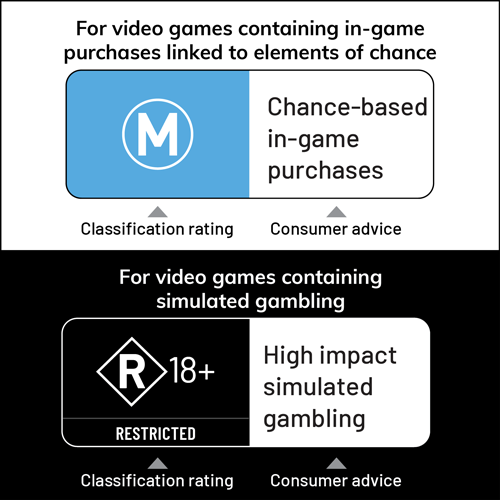
- Chance-based in-game purchases - for video games containing in-game purchases linked to elements of chance, like loot boxes.
- High-impact simulated gambling – for video games containing simulated gambling.
- Gambling themes – for video games containing content which may resemble gambling, but does not meet the threshold for simulated gambling.
Check out the below Resources - including info sheets and Stories.
Why have classifications changed
Gambling-like content in video games has become more common over the past decade.
Research shows links between gambling-like content in video games and gambling harms, emotional and mental health impacts.
The Australian Government made these changes in response to growing evidence as well as community concern.
What you can do
- Check the classification of the video games your children play or want to buy. You can use the search bar on the classification.gov.au website.
- Have a chat with your kids about the games they play. You can use the Conversation guide to support you.
- Learn from other parents, carers and grandparents by checking out Stories.
- You can set up parental controls to track and limit the content your children can access and how much they spend. Check out the parental controls info sheet or find out more at eSafety.gov.au.
Resources
Stories
Hear how Kylie uses classification advice to manage games her kids play
Kylie shares how she keeps a close eye on video games her three sons play.
Nadia and Zac's story
Nadia was surprised to find her 12-year-old son playing an M rated game with gambling-like content. Find out how she used classification advice to make some changes.
Trent and Harry's story
Gamer cousins found themselves caught out by gambling-like content. They didn’t realise they spent hundreds of dollars.
Sandra's story
Proud Wodi Wodi grandma is using classification advice to keep a closer eye on games her grandchildren play.
Joanne and Jackson's story
10-year-old Jackson is an avid gamer so Joanne was curious about the games her son was playing. She used classification advice to help make decisions and set up parental controls.
Hear from the experts
We invited leading voices across gaming, psychology, and parenting to share their insights on the impact of gambling-like content in video games: